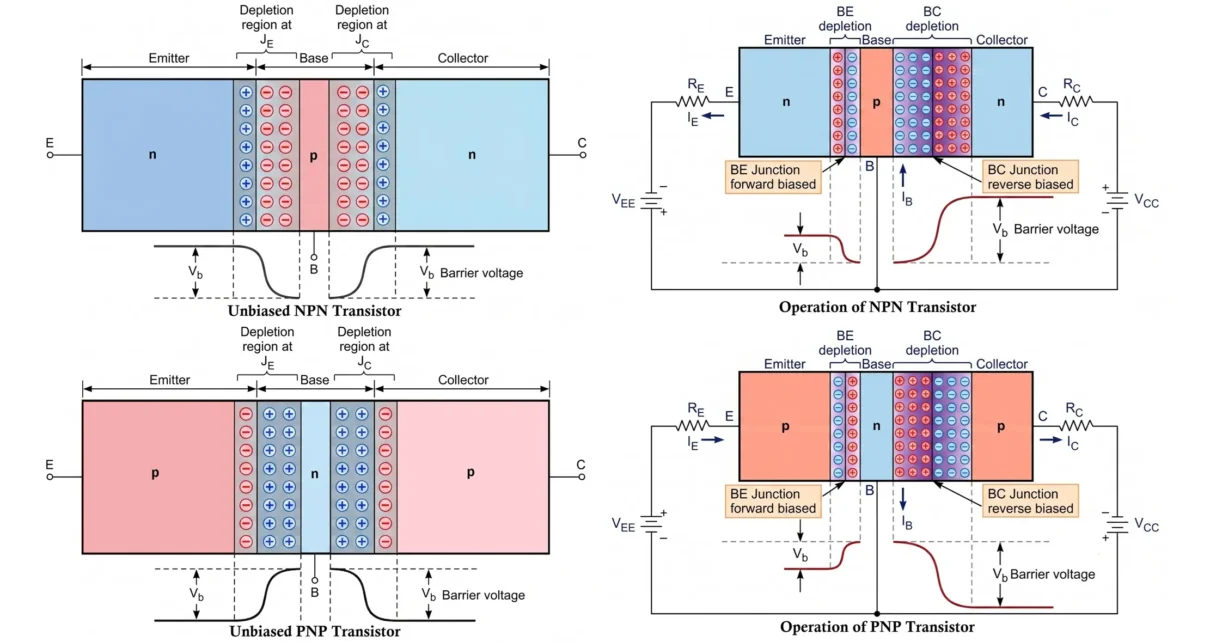
Let’s explore the biasing and operation of NPN and PNP transistors to understand how proper transistor biasing controls current flow, establishes the operating point (Q-point), and enables a bipolar junction transistor (BJT) to function as an amplifier or an electronic switch. The operation of a transistor depends on the biasing of its two PN junctions […]
Tag: Semiconductor Electronics
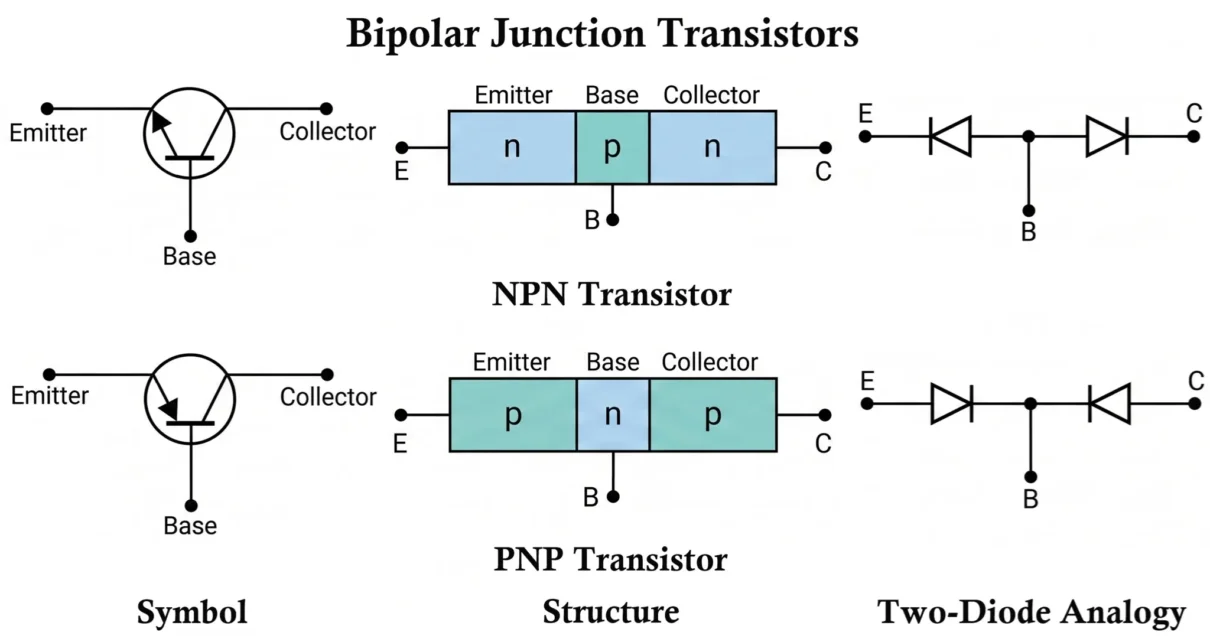
Structure of NPN and PNP Bipolar Junction Transistors
The Bipolar Junction Transistor (BJT) is one of the most important semiconductor devices used in modern electronic circuits. It consists of three semiconductor regions known as the emitter, base, and collector, which are formed by joining either two n-type regions with one p-type region or two p-type regions with one n-type region. Depending on this […]
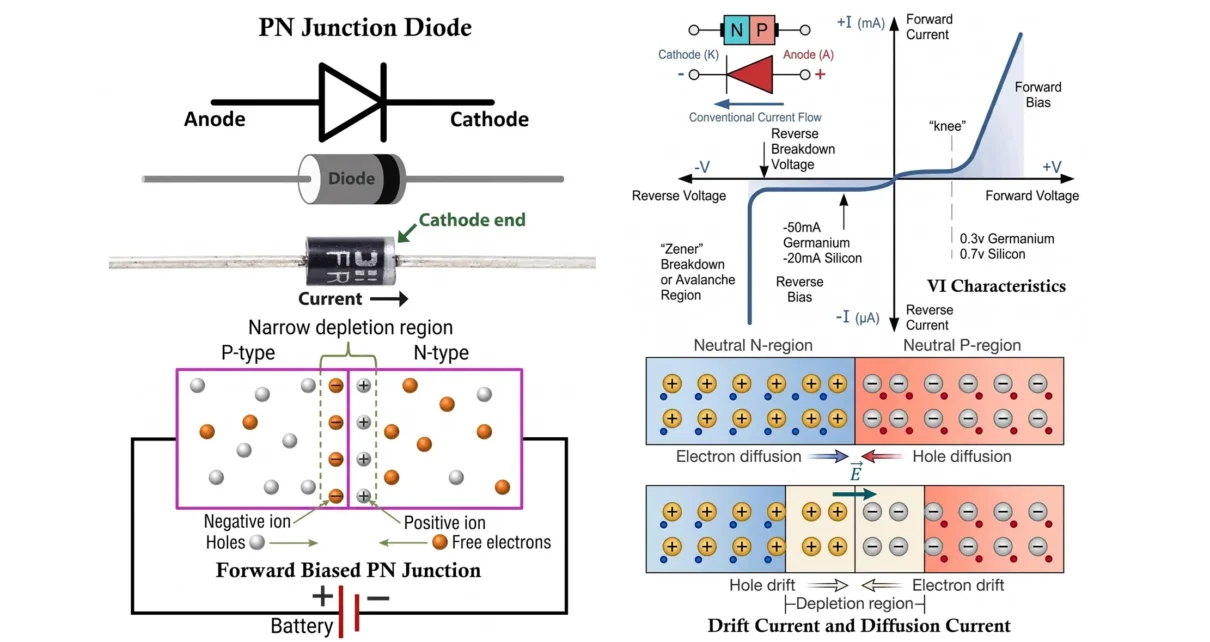
PN Junction Diode: Symbol, Construction, Working and VI Characteristics Explained
The PN junction diode is one of the most important and widely used semiconductor devices in electronics. It is created by joining a P-type semiconductor and an N-type semiconductor within a single crystal structure. This simple yet powerful device allows electric current to flow easily in one direction while offering very high resistance to current […]
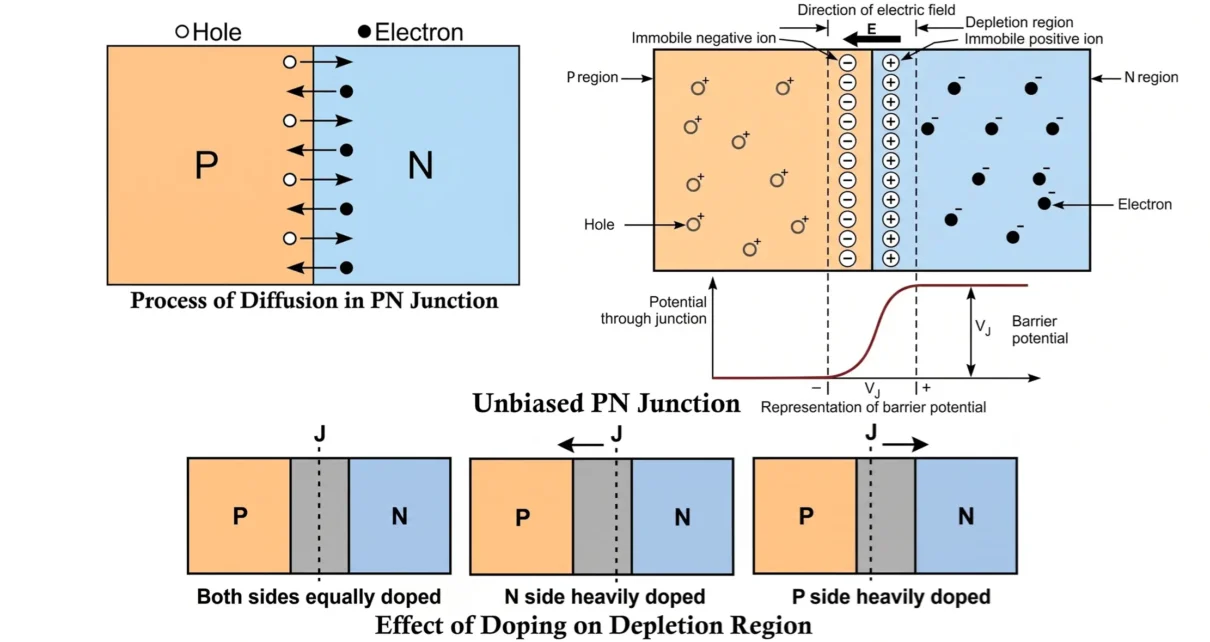
Unbiased PN Junction: Depletion Region and Barrier Potential
A PN junction is one of the most important structures in semiconductor electronics. It forms the basic building block of many electronic devices such as diodes, transistors, LEDs, solar cells, rectifiers, and integrated circuits. When a P-type semiconductor and an N-type semiconductor are joined together without applying any external voltage, the junction is called an […]
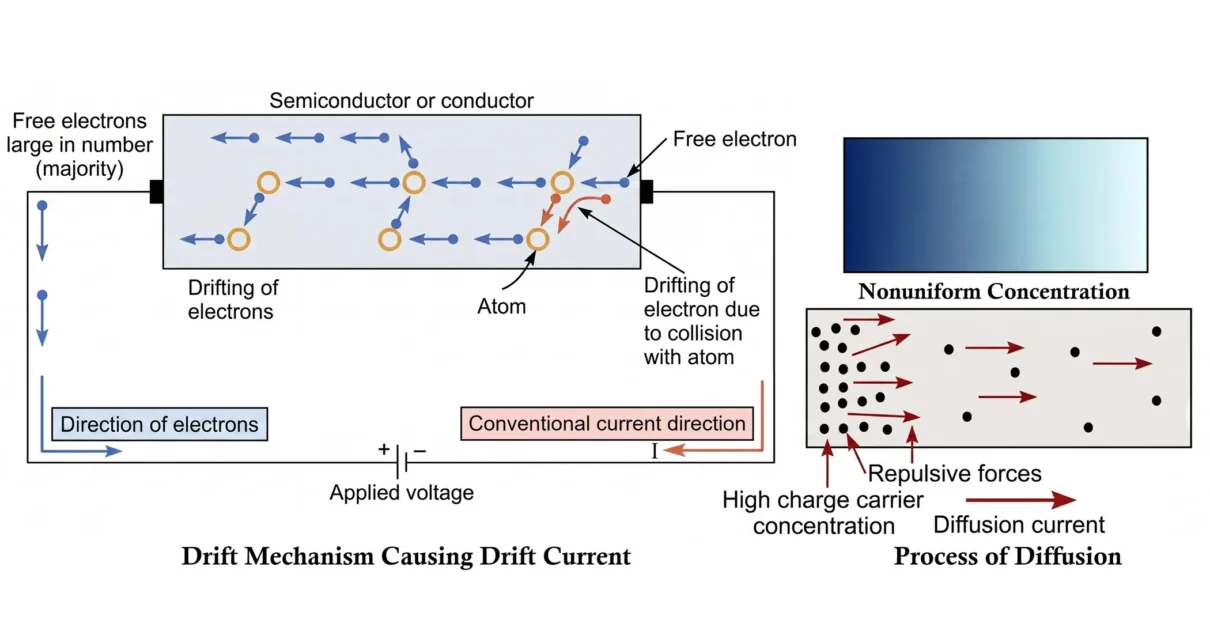
Drift Current and Diffusion Current in Semiconductors
Drift current and diffusion current are two fundamental mechanisms of charge transport in semiconductors. These concepts form the basis of semiconductor physics and are extremely important for understanding the operation of devices such as p-n junction diodes, transistors, LEDs, solar cells, MOSFETs, and integrated circuits. In semiconductors, electric current is produced not only by the […]
Difference Between Intrinsic and Extrinsic Semiconductor
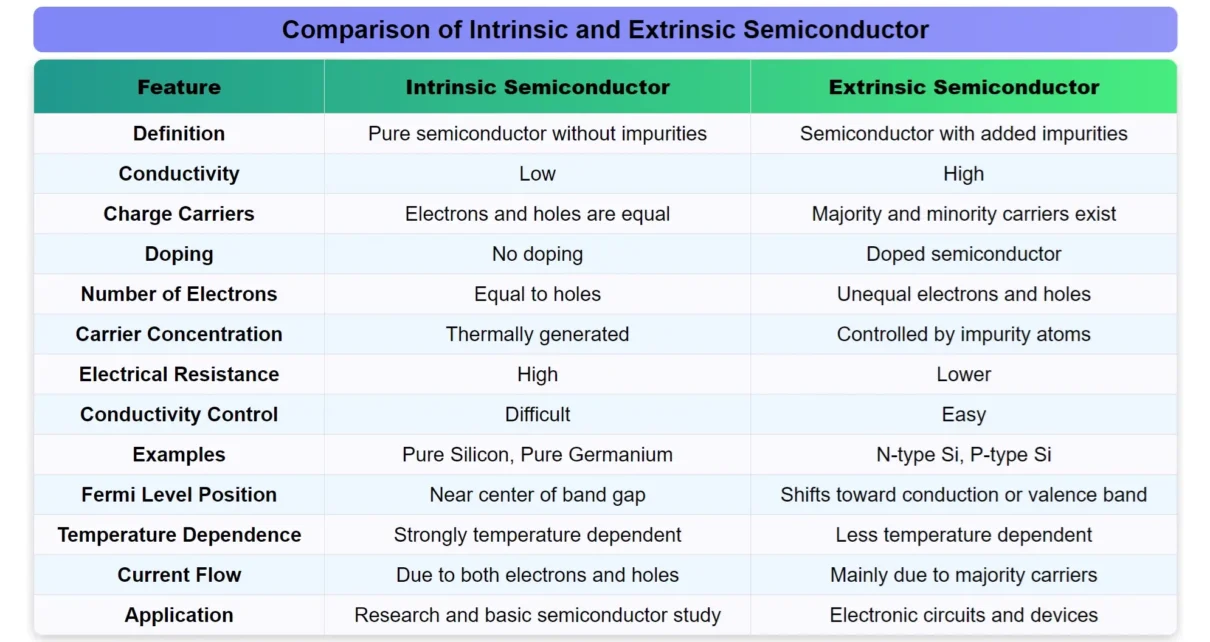
Semiconductors are the foundation of modern electronics and are widely used in devices such as diodes, transistors, integrated circuits, solar cells, sensors, and microprocessors. Based on the purity and conductivity characteristics, semiconductors are mainly classified into two types Intrinsic Semiconductor and Extrinsic Semiconductor. Understanding the difference between intrinsic and extrinsic semiconductors is extremely important in […]