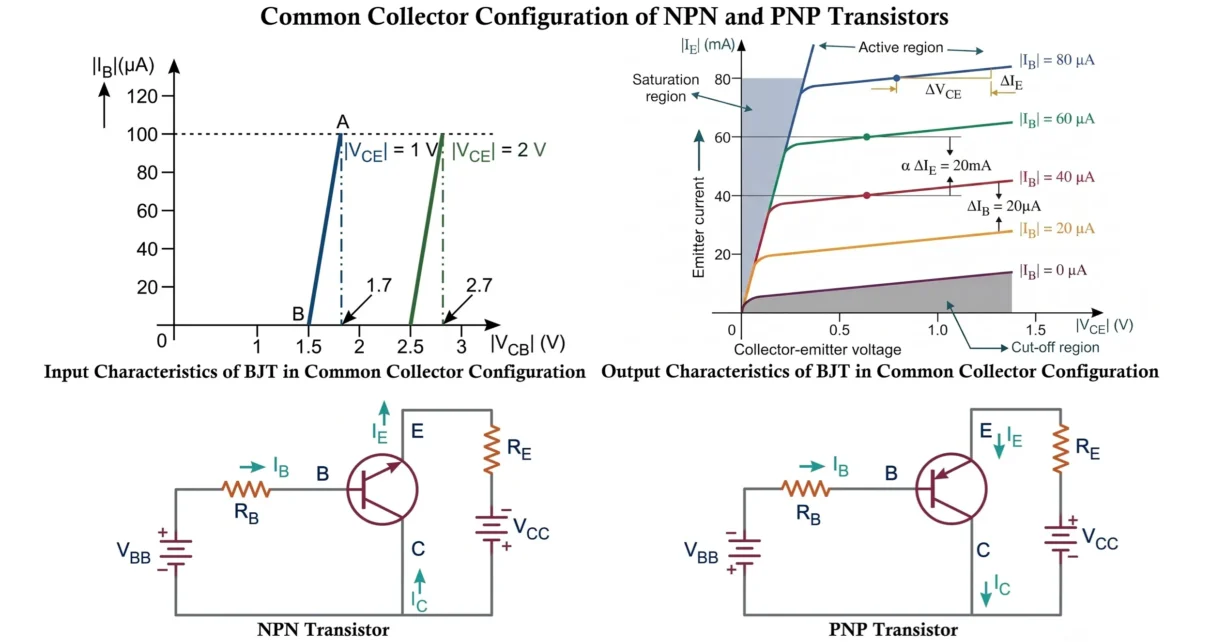
Common Collector Configuration is one of the three fundamental operating configurations of a Bipolar Junction Transistor (BJT), alongside the Common Base (CB) and Common Emitter (CE) configurations. In this configuration, the collector terminal is common to both the input and output circuits. The input signal is applied between the base and collector, while the output […]
Tag: Current amplification
Biasing and Operation of NPN and PNP Transistors
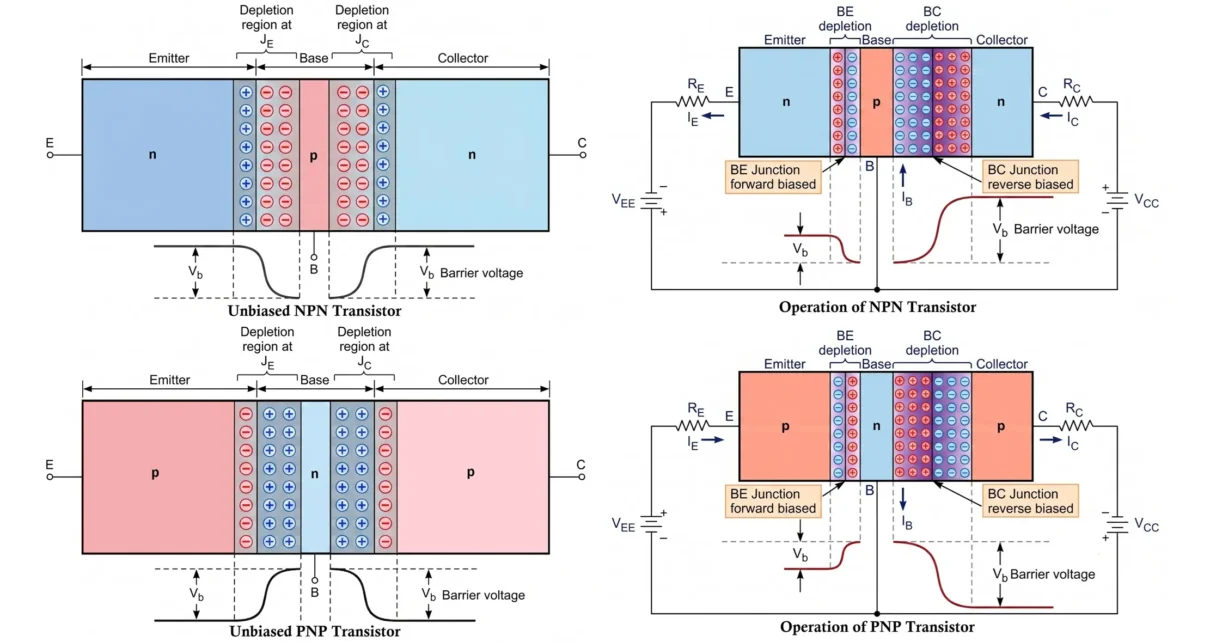
Let’s explore the biasing and operation of NPN and PNP transistors to understand how proper transistor biasing controls current flow, establishes the operating point (Q-point), and enables a bipolar junction transistor (BJT) to function as an amplifier or an electronic switch. The operation of a transistor depends on the biasing of its two PN junctions […]
Structure of NPN and PNP Bipolar Junction Transistors
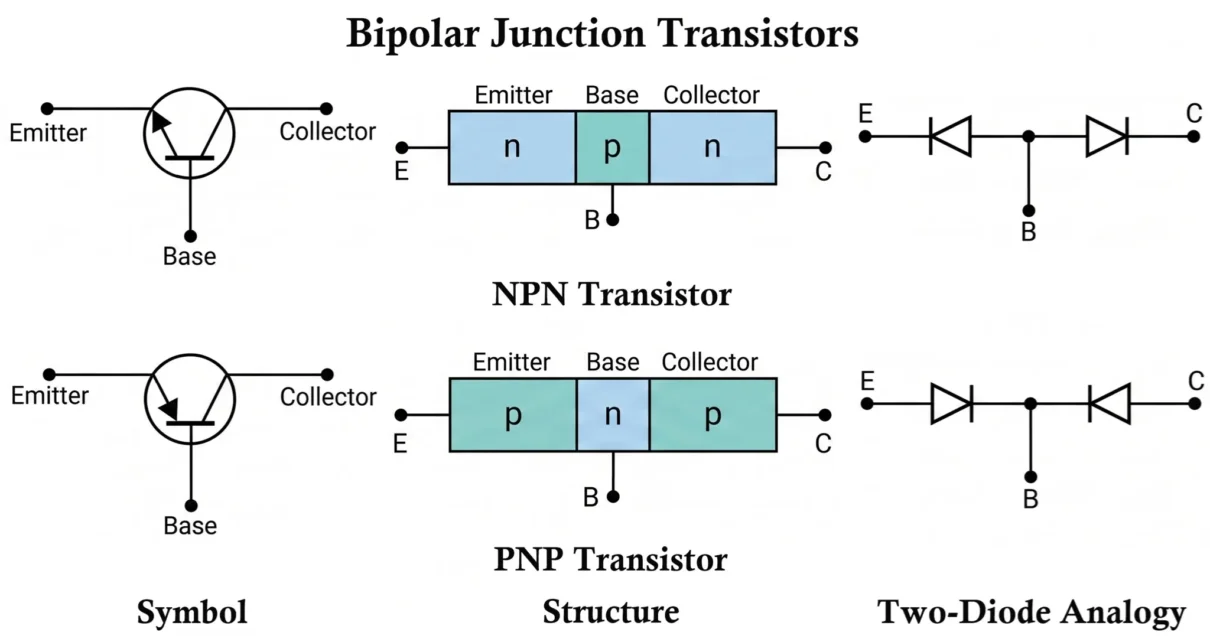
The Bipolar Junction Transistor (BJT) is one of the most important semiconductor devices used in modern electronic circuits. It consists of three semiconductor regions known as the emitter, base, and collector, which are formed by joining either two n-type regions with one p-type region or two p-type regions with one n-type region. Depending on this […]
Bipolar Junction Transistor (BJT): Construction, Working, Types, Characteristics and Applications
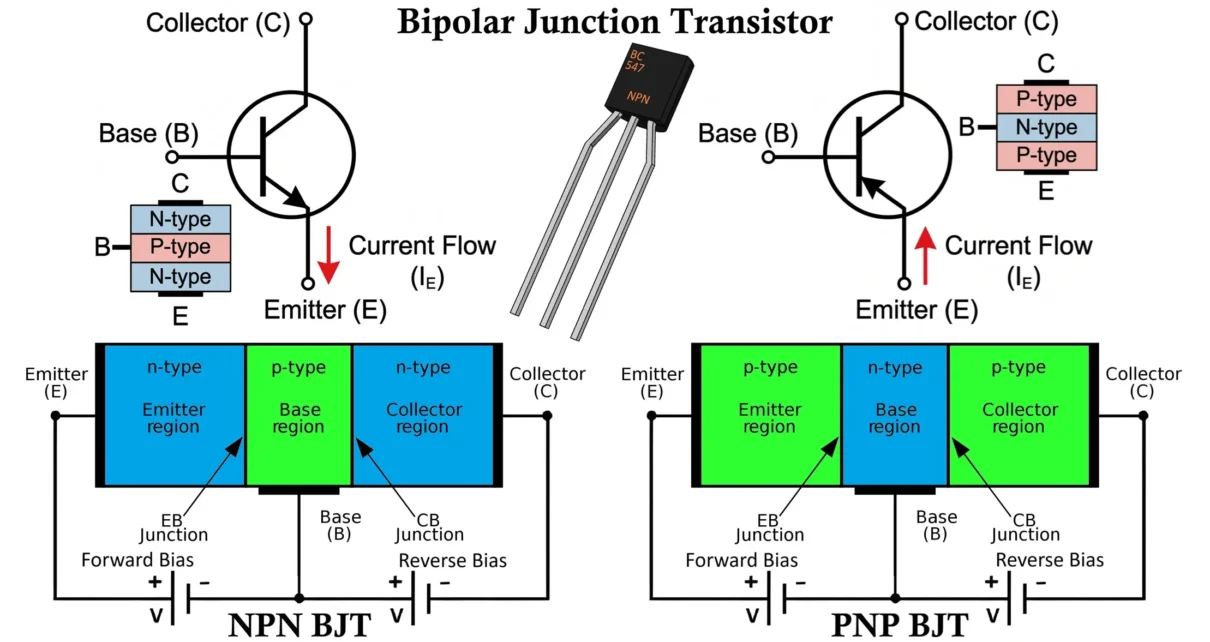
Bipolar Junction Transistors (BJTs) are widely used semiconductor devices for amplification and switching applications. A BJT consists of three layers of doped semiconductor material that form two PN junctions. These three regions are known as the Emitter, Base, and Collector. NPN and PNP are the two main types of Bipolar Junction Transistors. Unlike Field Effect […]