Inside any modern manufacturing facility, thousands of physical parameters change every millisecond. Pressure rises in hydraulic lines, motor bearings heat up, and conveyor belts shift position. Without real-time visibility into these dynamics, automated machinery would operate blindly. Industrial sensors act as the sensory organs of modern manufacturing, constantly converting physical phenomena into actionable data.
In automated plants, these devices deliver the continuous measurements necessary to monitor machine health, coordinate high-speed production, enforce safety protocols, and maintain strict product quality. While an industrial sensor often looks like a simple metal cylinder or plastic housing on the factory floor, its internal architecture unites basic electronic principles with advanced signal processing.
Underneath the rugged enclosure lies a carefully engineered functional chain: physical sensing elements, precision analog amplification, digital processing, and standardized communication interfaces. Accurate automation relies on reliable data, and that data journey always begins at the sensor.
Related Articles:
- Motion Sensor Light Circuit Diagram and Working
- Arduino Weather Station Project with BME680 Sensor
- How Control Modules Power Modern Automation
- Interfacing DHT11 + Soil Moisture Sensor with Arduino & ESP32
- Water Quality Monitoring System: TDS Sensor + ESP32/Arduino
- Applications of Common Electrical Sensors in Modern Healthcare
- What is a Sensor? Types of Sensors, Classification & Applications
What Is an Industrial Sensor and How Does It Work?
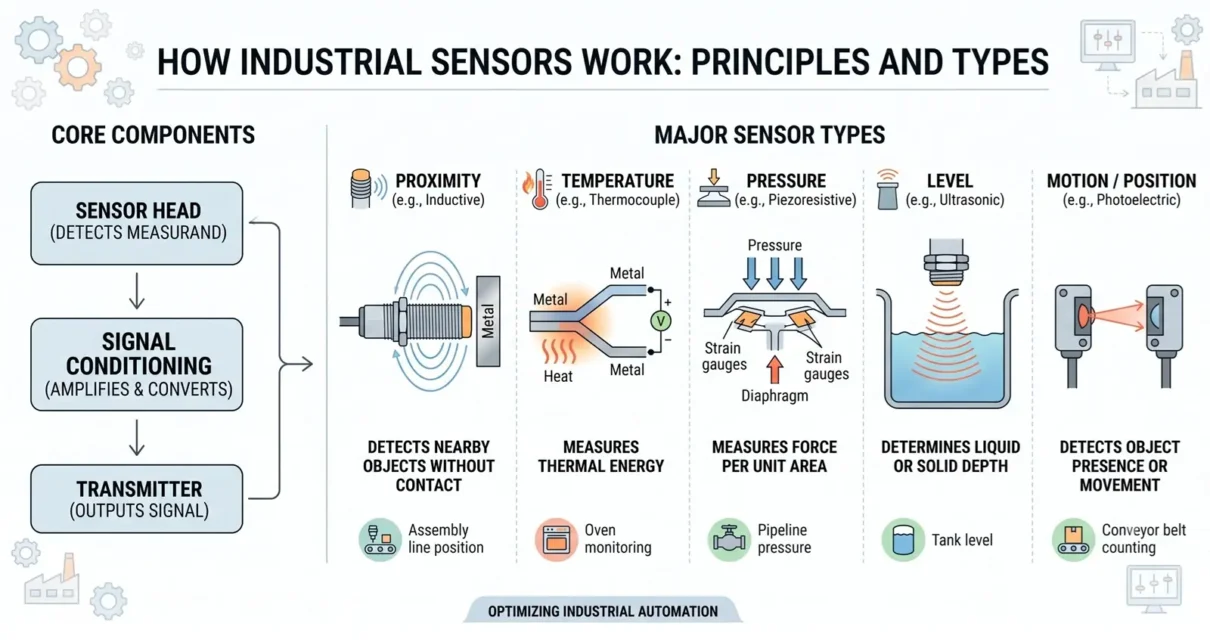
At its core, an industrial sensor is a transducer that detects a physical property and converts it into a quantitative electrical signal. This fundamental transformation allows electronic controllers to interpret, record, and respond to real-world physical changes.
The general operational workflow follows three sequential steps.
First, the detection phase occurs when the sensing element encounters a physical change such as a shift in temperature, hydraulic pressure, mechanical position, light intensity, or physical proximity.
Second, signal conversion translates this physical response into an electrical variable. Analog sensors output continuous voltage (such as 0–10 V) or current loops (such as 4–20 mA) proportional to the measured property. Digital sensors, by contrast, output discrete binary states (ON or OFF) to indicate threshold triggers or encoded data packets.
Third, internal or external signal processing conditions the raw electrical output through filtering and amplification, making it robust enough for long-distance transmission to Programmable Logic Controllers (PLCs), edge devices, or centralized plant monitoring platforms.
Sensors never operate in isolation; they are integral elements within a broader closed-loop control ecosystem.
Common Types of Industrial Sensors and Their Applications
Different industrial processes require distinct sensing technologies to evaluate physical parameters reliably under demanding operational conditions.
| Sensor Type | Working Principle | Typical Industrial Applications |
| Proximity Sensors | Detects target presence or distance without physical contact using electromagnetic or capacitive fields. | Automated assembly lines, part presence checking, machine tool positioning. |
| Temperature Sensors | Measures thermal changes using resistance changes (RTDs) or thermoelectric voltage (thermocouples). | Chemical process control, plastic injection molding, motor thermal protection. |
| Pressure Sensors | Converts fluid or gas strain on a piezoresistive element into proportional electrical signals. | Hydraulic press monitoring, pneumatic systems, leak detection testing. |
| Photoelectric Sensors | Uses focused light beams (thru-beam, retro-reflective, or diffuse) to detect object presence. | High-speed packaging lines, bottle counting, sorting systems. |
| Encoder Sensors | Translates mechanical rotation or linear motion into digital pulse trains or absolute position codes. | Servo motor speed control, robotic joint tracking, CNC motion positioning. |
Proximity Sensors: A Simple Example of Industrial Detection
To understand how basic electronics translate into industrial-grade hardware, consider the ubiquitous proximity sensor. In our field diagnostics, we frequently encounter two primary designs: inductive and capacitive.
Inductive proximity sensors generate a high-frequency alternating magnetic field across their sensing face using an internal LC oscillator circuit. When a metallic target enters this magnetic field, eddy currents are induced in the metal, drawing energy away from the oscillator and reducing its amplitude. A trigger circuit detects this drop in amplitude and toggles the sensor’s solid-state switch output.
Capacitive sensors operate on a related principle but measure changes in electrostatic capacitance between the sensor’s electrode plates and the target material, allowing them to detect non-metallic substances such as liquids, powders, and plastics.
Because non-contact detection eliminates mechanical wear, these sensors dramatically improve machine uptime, allow faster line speeds, and extend operational lifespans compared to electromechanical limit switches. When connected to a PLC input module, a simple 24V DC proximity signal provides the precise timing needed for high-speed machine indexing.
The Electronics Inside an Industrial Sensor
While a proximity switch demonstrates basic detection, modern industrial sensors contain complex electronic subsystems engineered to ensure signal integrity across noisy factory environments. Raw physical signals are inherently weak and susceptible to interference, requiring immediate conditioning inside the sensor housing.
Key Internal Components
The internal architecture of an advanced industrial sensor typically comprises four functional stages:
- Sensing Element: The primary transducer such as a strain gauge, thermistor, or photodiode that directly interacts with the physical parameter.
- Signal Conditioning Circuitry: Precision operational amplifiers and active filters that boost millivolt-level signals and eliminate high-frequency electromagnetic noise.
- Microcontroller & Processing Unit: Embedded microcontrollers that perform analog-to-digital conversion (ADC), temperature compensation, sensor calibration, and real-time self-diagnostics.
- Communication Interface: Output drivers that convert processed data into robust 4–20 mA current loops, digital switching outputs, or digital fieldbus frames like IO-Link.
Engineers designing measurement systems often refer to international guidelines such as those published in the International Electrotechnical Commission (IEC) standards for industrial automation to ensure electrical safety, noise immunity, and device interoperability across global manufacturing installations.
From Individual Sensors to Smart Factory Systems
The role of industrial sensors has expanded rapidly over the past decade. Historically, sensors served as localized binary switches or isolated transmitters detecting a condition, sending a single voltage spike to a PLC, and triggering an immediate mechanical actuator response.
Smart manufacturing transforms this linear architecture into a networked ecosystem.
Modern sensor architectures transmit continuous operational streams back to centralized software platforms. Through the Industrial Internet of Things (IIoT), sensors collect rich multidimensional data, enabling real-time condition monitoring, automated quality tracking, and data-driven production scheduling. Instead of waiting for a bearing to fail, vibration and temperature sensors provide predictive maintenance insights, allowing maintenance crews to service hardware before catastrophic failure occurs.
How Sensors Communicate with Control Systems
Understanding the communication path between field hardware and the control cabinet is essential for understanding modern automation. The control loop operates in a structured sequence:
Sensor → PLC Input Module → Control Logic → PLC Output Module → Machine Action
Field sensors deliver raw electrical inputs to PLC input cards, where hardware interfaces isolate and digitize the signals. The controller executes its program logic, calculates required outputs, and commands actuators such as hydraulic valves, contactors, or servo drives to perform physical work.
For engineers researching automation hardware, industrial sensor systems are commonly integrated alongside controllers, communication modules, and other industrial automation components used in factory control environments.
Challenges in Industrial Sensor Applications
Deploying electronics on the factory floor presents physical challenges that benchtop circuits never encounter. Sensors must maintain tight tolerances while enduring extreme temperature variations, persistent mechanical vibration, abrasive dust, high-pressure washdowns, and intense electromagnetic interference (EMI) from high-voltage motor drives.
Key engineering considerations during integration include:
- Environmental Protection: Selecting appropriate ingress protection (IP) ratings, such as IP67 or IP69K, to shield internal electronics from liquid and particulate penetration.
- Signal Degradation & Shielding: Utilizing shielded twisted-pair cabling and differential signaling to prevent electrical noise from corrupting low-voltage measurement lines.
- Calibration & Drift: Establishing periodic recalibration schedules to offset component aging and thermal drift over prolonged operation.
Advanced sensors significantly improve operational efficiency, but achieving reliable long-term accuracy requires careful sensor selection, proper grounding practices, and disciplined maintenance protocols.
The Future of Industrial Sensors in Smart Manufacturing
As processing power moves closer to the physical sensing point, sensors are becoming increasingly autonomous. Micro-electromechanical systems (MEMS) technology continues to shrink physical dimensions while increasing measurement sensitivity, allowing multi-axis vibration and thermal sensing to be embedded directly inside compact motor housings.
Edge computing plays a critical role in this evolution. Instead of streaming raw, high-frequency waveforms across factory networks, modern edge-enabled sensors analyze spectral data internally, transmitting only diagnostic summaries or anomaly alerts. Combined with wireless sensor networks and machine-learning algorithms, these devices form the backbone of next-generation predictive maintenance strategies.
Sensors as the Bridge Between Electronics and Automation
Industrial sensors bridge the gap between basic electronic principles and complex automated factories. From a simple inductive coil detecting a metal gear tooth to an intelligent IO-Link sensor streaming diagnostic metrics, these devices transform raw physical phenomena into precise digital intelligence.
As manufacturing facilities continue to adopt higher levels of automation, mastering the core principles of sensor electronics remains an indispensable foundation for engineers, technicians, and automation specialists alike.
Beyond the Circuit Board: How Control Modules Power Modern Automation
What is a Sensor? Types of Sensors, Classification & Applications
ESP32 Home Automation Project by Google Assistant, Blynk & IFTTT
Interfacing DHT11 + Soil Moisture Sensor with Arduino & ESP32

