Modern industrial automation does not run on raw circuit boards alone; it depends on structured layers of electronic architecture. While a printed circuit board provides the foundational wiring for individual components, turning a static design into an active machine requires deterministic control logic, robust physical signal interfaces, and reliable data transmission.
A single custom circuit board can illuminate an LED or spin a basic motor, but operating a multi-axis CNC machine or an automated bottling line demands far greater system resilience. The system must process inputs from hundreds of field sensors, execute complex state algorithms within millisecond execution cycles, and send physical commands to heavy actuators without succumbing to electrical noise.
Control modules form the indispensable bridge between decision-making processors and physical machinery. By consolidating raw silicon, isolated I/O interfaces, and fieldbus communication capabilities into modular enclosures, these units enable the transition from isolated electronic circuits to unified, intelligent industrial networks.
Related Articles:
- Motion Sensor Light Circuit Diagram and Working
- Arduino Weather Station Project with BME680 Sensor
- ESP32 Home Automation Project by Google Assistant & Blynk
- Interfacing DHT11 + Soil Moisture Sensor with Arduino & ESP32
- Water Quality Monitoring System: TDS Sensor + ESP32/Arduino
- Applications of Common Electrical Sensors in Modern Healthcare
- What is a Sensor? Types of Sensors, Classification & Applications
What Is a Control Module?
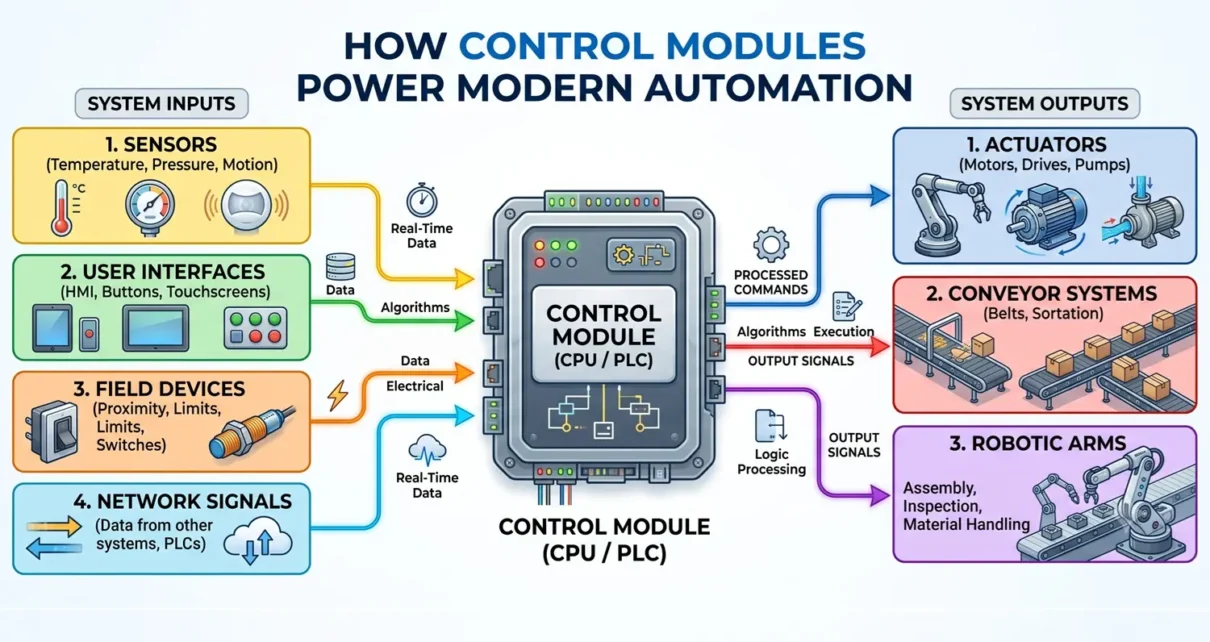
At its core, a control module is an integrated electronic system designed to ingest field signals, process deterministic control algorithms, and drive external machinery. Unlike general-purpose printed circuit boards built for single-function consumer devices, control modules are engineered to operate continuously in harsh electromagnetic and thermal environments.
While a standard PCB executes fixed electrical pathways, a modern control module acts as a self-contained processing node. Inside its enclosure, the module combines several specialized sub-circuits working in unison:
- Processing Cores: Microcontrollers or microprocessor units (MPUs) optimized for real-time operational logic.
- Volatile & Non-Volatile Memory: Flash and RAM modules dedicated to storing program execution code, operational parameters, and system fault logs.
- Isolated Signal Interfaces: Optically or galvanically isolated input/output circuits engineered to withstand severe voltage spikes.
- Network Communication Drivers: Physical layer transceivers supporting industrial Ethernet and serial bus protocols.
These modular sub-systems appear across nearly every domain of modern technology, including high-speed bottling plants, robotic welding cells, railway traction controllers, grid-scale energy storage management systems, and automated HVAC infrastructure.
The Electronic Building Blocks Inside a Control Module
Inside any industrial control module lies a carefully coordinated architecture designed to balance compute power, electrical isolation, and deterministic response times.
Microprocessors and Controllers: The Decision-Making Core
The processing architecture inside a control module dictates its execution capability and real-time responsiveness. Depending on the operational demands, design engineers select specific silicon controllers tailored to the control task.
| Architecture Class | Primary Role | Typical Application |
| Microcontroller (MCU) | Executes dedicated embedded tasks with low latency and precise hardware timing. | Compact motor drives, valve positioners, and localized sensor hubs. |
| Industrial Controller (PLC/PAC) | Manages multi-variable machine logic, high I/O density, and complex state machines. | Factory assembly lines, process automation, and safety shutdown systems. |
| Communication Processor | Offloads network protocol stack processing from the primary control loop. | Fieldbus gateways, edge telemetry nodes, and industrial network bridges. |
When we evaluate control hardware performance, cycle time consistency matters far more than raw clock speed. A system running at 200 MHz with deterministic hardware interrupts will consistently outperform a faster processor that experiences random execution jitter.
Input and Output Circuits: Connecting Electronics With the Physical World
An industrial processor cannot directly interface with 24V industrial sensors or high-current motor drives without risk of hardware destruction. Input circuits use optical isolators, low-pass RC filters, and analog-to-digital converters (ADCs) to condition incoming signals from proximity switches, optical encoders, and thermocouple probes.
On the output side, commands generated by the core processor pass through driver transistors, solid-state relays, or digital-to-analog converters (DACs). These output drivers energize pneumatic solenoids, adjust variable frequency drives, or trigger safety relays. Modular I/O configurations allow control engineers to expand or modify these physical interfaces without replacing the main processing unit.
How Control Modules Work in an Automation System
To understand the operation of a control module, consider its role within the closed-loop control cycle: Sensors → Input Module → Control Module → Output Module → Machine Action.
First, environmental sensors measure physical variables such as pressure, temperature, or mechanical position. Second, the input module converts these raw physical phenomena such as a 4–20 mA current loop or a 0–10 V signal into a digitized data stream readable by the processor.
Third, the control module evaluates this incoming data against predefined logic algorithms, PID loop parameters, or conditional interlocks. Finally, the output module converts the processed decision into electrical energy that energizes an actuator or modifies motor speed.
Consider an automated high-speed packaging line. A photoelectric sensor detects an arriving cardboard carton and sends an input pulse to the control module. Within microseconds, the controller calculates the belt velocity, verifies downstream buffer capacity, and signals an output module to fire a pneumatic push-rod ensuring perfect alignment without interrupting production velocity.
Control Modules vs Traditional Circuit Boards: What Has Changed?
The evolution from dedicated, single-function circuit boards to modular control hardware represents a shift from fixed hardware designs to software-programmable flexibility.
| Feature | Traditional Circuit Board | Modern Control Module |
| Functionality | Hardwired to perform specific, fixed electrical operations. | Executes reconfigurable, software-defined control logic. |
| Flexibility | Requires physical component modifications or re-spinning layouts to alter logic. | Updated via software flashes, fieldbus configuration, or remote parameter adjustments. |
| Communication | Limited to point-to-point analog wiring or basic serial links. | Supports high-speed industrial Ethernet and deterministic fieldbus topologies. |
| Deployment Environment | Designed primarily for protected consumer or light electronic enclosures. | Ruggedized against heavy mechanical vibration, thermal extremes, and high EMC noise. |
This structural change reduces downtime dramatically. When functional requirements shift on a factory floor, technicians adjust software logic or swap modular field cards instead of designing new custom PCB layouts.
The Role of Control Modules in Smart Manufacturing
Smart manufacturing relies on the seamless flow of operational telemetry from the shop floor to enterprise monitoring systems. Modern control modules serve as the primary data collection nodes for this architecture, providing visibility into machine health, cycle counts, and energy consumption.
By decentralizing processing tasks, edge-capable control modules perform real-time diagnostics directly at the machine level. This enables predictive maintenance routines that detect subtle vibration changes or thermal anomalies long before hardware failure occurs.
To maintain seamless interoperability across global supply chains, connected equipment designs adhere to established frameworks like those outlined in the International Organization for Standardization (ISO) industrial automation standards. These guidelines establish baseline requirements for data interchange, safety functions, and system integration.
Communication Technologies Behind Modern Modules
Reliable network connectivity forms the backbone of smart factory architectures. Control modules utilize a hierarchy of deterministic protocols to exchange data without transmission delays:
- Industrial Ethernet: High-bandwidth protocols like PROFINET and EtherNet/IP for real-time controller-to-controller synchronization.
- Deterministic Fieldbuses: Low-latency field device communications including EtherCAT and Modbus TCP.
- Sensor-Level Networks: Point-to-point digital standards such as IO-Link for comprehensive parameter configuration at the sensor head.
- Wireless Industrial Networks: Secure short-range radio protocols used for telemetry monitoring on mobile equipment like Automated Guided Vehicles (AGVs).
Integrated communications allow engineers to isolate faults remotely, reducing diagnostic times from hours to minutes.
Choosing the Right Control Module for an Application
Selecting control hardware requires balancing compute performance, electrical characteristics, and environmental durability. Overspecifying hardware drives up system costs unnecessarily, while underestimating operational stresses leads to premature field failures.
Design teams evaluate several critical metrics during hardware selection: required processing speed, total I/O point count, signal conditioning types, operating temperature ranges, and electromagnetic compatibility (EMC) compliance.
When specifying hardware for system retrofits, design teams frequently analyze specialized industrial control modules against strict noise immunity and deterministic cycle time parameters. Ensuring native protocol compatibility with existing backplanes avoids costly protocol translation hardware.
Future Trends: Smaller, Smarter, and More Connected Modules
Industrial control technology continues to evolve toward higher power densities and distributed intelligence. Wide-bandgap semiconductors, such as Gallium Nitride (GaN) and Silicon Carbide (SiC), are enabling smaller power stages with significantly reduced thermal losses.
At the same time, micro-machine learning (MicroML) algorithms are moving directly onto embedded microcontrollers. This allows individual control modules to analyze waveform anomalies locally, performing complex signal filtering without relying on cloud processing bandwidth.
Hardware-level cybersecurity is also becoming standard. Modern control modules incorporate secure boot elements, encrypted memory zones, and signed firmware verification to protect critical infrastructure against unauthorized tampering.
Control Modules Are the Hidden Foundation of Automation
Control modules transform static electronic circuits into dynamic, intelligent control systems. By combining real-time compute cores, isolated I/O interfaces, and deterministic networking, these units allow automated machinery to sense, analyze, and act with extreme precision.
As factories move toward higher levels of connectivity and autonomy, the humble control module remains the essential foundation connecting digital logic to the physical world.
What is a Sensor? Types of Sensors, Classification & Applications
ESP32 Home Automation Project by Google Assistant, Blynk & IFTTT
Interfacing DHT11 + Soil Moisture Sensor with Arduino & ESP32

