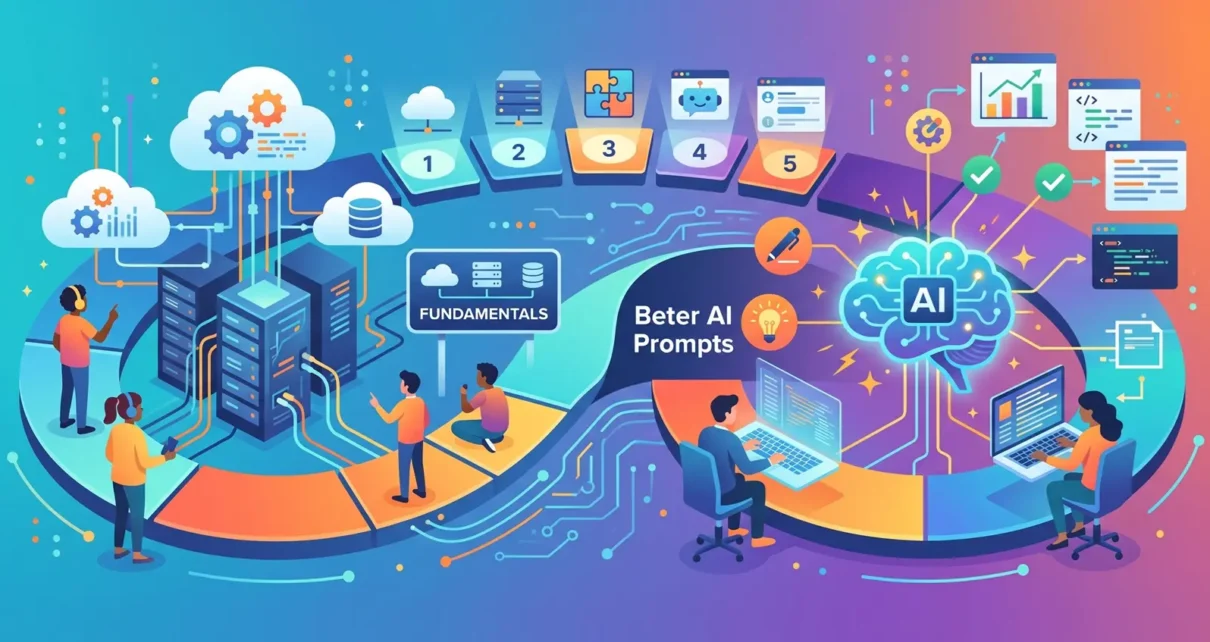
Cloud computing and AI can seem like two separate subjects when you first encounter them. One talks about servers, storage, and security. The other focuses on models, prompts, and generated responses.
In practice, they are closely connected. Cloud platforms provide the infrastructure behind many digital services, while prompt engineering helps people communicate more effectively with AI systems.
These five courses offer a manageable starting point for beginners who want to understand both areas without taking on too much at once.
Related Articles:
- What is Artificial Intelligence in Computer Science
- Artificial Intelligence vs Human Intelligence
- Artificial Intelligence in Electronics: From Design to Production
- Cloud Video Surveillance for Network Security in Smart Factories
- Deploying Neural Networks on Microcontrollers: Tools & Techniques
How We Selected These Cloud and AI Courses
Beginner Fit: Each course needed to work for learners with limited cloud or AI experience.
Practical Coverage: We looked for demonstrations, exercises, sample prompts, or applied learning.
Clear Scope: Every course had to focus on a useful starting skill, such as cloud infrastructure, AWS services, or prompt design.
Provider Credibility: The list includes established technology learning platforms with clearly defined curricula.
Overview: Best Cloud and Prompt Engineering Courses for Beginners
| # | Course | Provider | Primary Focus | Delivery | Ideal For |
| 1 | AWS For Beginners | Great Learning Academy | AWS services, EC2, S3, IAM, cloud models | Online, self-paced | Beginners who want to learn AWS free |
| 2 | Cloud Computing Fundamentals: Cloud Concepts | Pluralsight | Deployment models, networking, storage, cloud design | Online, self-paced | Learners building general cloud knowledge |
| 3 | Prompt Engineering for ChatGPT | Great Learning Academy | LLMs, tokenization, prompt techniques, model comparison | Online, self-paced | Beginners seeking an introduction to prompt engineering |
| 4 | ChatGPT Prompt Engineering for Developers | DeepLearning.AI | Prompt design, LLM APIs, application workflows | Online, self-paced | Learners with basic Python familiarity |
| 5 | Introduction to Prompt Engineering for Generative AI | LinkedIn Learning | Text prompts, multimodal AI, few-shot prompting, APIs | Online, self-paced | Beginners using multiple generative AI tools |
5 Courses for Tech Beginners Moving from Cloud Basics to Better AI Prompts
1. AWS For Beginners – Great Learning Academy
This course is a practical starting point for learners who want to learn AWS free and understand what cloud platforms actually do. It begins with basic cloud terminology before introducing widely used AWS services for computing, storage, and access management.
The lessons also explain how businesses use AWS to improve scalability, flexibility, security, and cost management. No prior cloud experience is required.
Delivery & Duration: Online, self-paced, 4.5 learning hours.
Credentials: Completion certificate available after successful course completion with the applicable certificate fee. This is not an official AWS certification.
Instructional Quality & Design: Covers cloud computing fundamentals, AWS global infrastructure, deployment models, IaaS, PaaS, SaaS, EC2, S3, IAM roles, security groups, scalability, cost, and security.
Support: Free course content, quizzes, demonstrations, and hands-on practice with AWS concepts.
Key Outcomes / Strengths
- Understand how AWS and public cloud infrastructure work.
- Distinguish between IaaS, PaaS, and SaaS service models.
- Learn how EC2 instances provide cloud-based computing capacity.
- Compare storage options such as Amazon S3 for different data needs.
- Understand how IAM roles and security groups protect cloud resources.
2. Cloud Computing Fundamentals: Cloud Concepts – Pluralsight
This course is useful for beginners who want cloud knowledge that is not tied to just one provider. It explains the ideas that appear across AWS, Microsoft Azure, Google Cloud, and other platforms.
The course covers how cloud environments are deployed, connected, secured, and designed for reliability. This broader view can make vendor-specific services easier to understand later.
Delivery & Duration: Online, self-paced, 1 hour 35 minutes.
Credentials: Pluralsight certificate of completion available through an active plan. Course access is also available through a trial.
Instructional Quality & Design: Covers cloud deployment models, shared responsibility, networking, connectivity, load balancing, DNS, firewalls, storage technologies, redundancy, high availability, disaster recovery, and recovery objectives.
Support: Structured modules, platform progress tracking, and access through Pluralsight plans or trial options.
Key Outcomes / Strengths
- Understand the differences between public, private, hybrid, and community clouds.
- Learn the basic networking terms used across cloud platforms.
- Compare file, block, and object storage technologies.
- Understand shared responsibility between cloud providers and customers.
- Learn why redundancy and disaster recovery matter in cloud design.
3. Prompt Engineering for ChatGPT – Great Learning Academy
This course offers an introduction to prompt engineering while also explaining what happens behind an AI-generated response. It covers how large language models are trained, how text is divided into tokens, and why prompt wording can change the quality of an answer.
The later modules move into zero-shot and few-shot prompting, model comparison, and hands-on sample prompt execution. This gives beginners both background knowledge and practical techniques.
Delivery & Duration: Online, self-paced, 3 learning hours across 8 modules.
Credentials: Completion certificate available after successful course completion with the applicable certificate fee.
Instructional Quality & Design: Covers LLM training and inference, GPT architecture, OpenAI model development, tokenization, model deployment, operationalizing generative AI, prompt design, zero-shot prompting, few-shot prompting, and sample prompt execution.
Support: Free course content, quizzes, sample prompts, self-paced access, and lifetime course access after enrollment.
Key Outcomes / Strengths
- Understand how large language models process prompts and generate responses.
- Write clearer instructions with enough context and useful constraints.
- Apply zero-shot and few-shot prompting to different tasks.
- Compare outputs across ChatGPT 4.5, o1, and o3-mini.
- Review and refine AI responses instead of accepting the first result.
4. ChatGPT Prompt Engineering for Developers – DeepLearning.AI
This short course is aimed at learners who want to move from conversational prompting into simple AI application workflows. Basic Python comfort is helpful because the lessons use notebooks and API-based examples.
The course is taught by Isa Fulford from OpenAI and Andrew Ng. It explains prompt-writing principles, then shows how those principles can be used for tasks such as summarization, information extraction, rewriting, and chatbot development.
Delivery & Duration: Online, self-paced, approximately 1.5 hours.
Credentials: Short-course completion record available through the DeepLearning.AI learning platform.
Instructional Quality & Design: Covers prompt-writing guidelines, iterative prompt development, summarizing, inferring, transforming text, expanding content, and building a basic chatbot with an LLM API.
Support: Built-in notebook environment, code examples, and guided demonstrations.
Key Outcomes / Strengths
- Write prompts that provide clearer instructions and context.
- Use LLMs for summarization, classification, extraction, and rewriting.
- Improve prompts through testing and iterative refinement.
- Work with an LLM through an API rather than only a chat interface.
- Build a basic conversational workflow using Python.
5. Introduction to Prompt Engineering for Generative AI – LinkedIn Learning
This beginner course takes a broader view of prompting across several generative AI platforms. It covers text tools such as ChatGPT, Gemini, Copilot, and Claude, along with image-generation tools such as DALL-E and Midjourney.
The course also introduces zero-shot and few-shot prompting, custom GPTs, multimodal models, fine-tuning, and API interaction. The lessons remain short, so the course does not feel overly technical.
Delivery & Duration: Online, self-paced, 1 hour 3 minutes.
Credentials: Shareable LinkedIn Learning Certificate of Completion.
Instructional Quality & Design: Includes lessons on LLMs, tokens, text generation, zero-shot and few-shot prompting, AI image generation, custom GPTs, multimodality, fine-tuning, responsible use, and API interaction.
Support: Five quizzes, mobile access, downloadable course access through the app, and structured lesson progression.
Key Outcomes / Strengths
- Understand how prompts work across several popular AI tools.
- Practice both zero-shot and few-shot prompting.
- Learn how prompt choices affect text and image generation.
- Build awareness of multimodal AI and custom GPT workflows.
- Review responsible-use considerations before using generated content.
Final Thoughts
Cloud computing and prompt engineering become easier to understand when they are treated as connected layers. Cloud knowledge explains where digital services run and how resources are stored, connected, and protected. Prompt engineering explains how people guide AI tools toward clearer and more useful outputs.
When comparing free courses, it helps to focus on whether the material gives you a clear mental model and enough practice to test what you have learned. Understanding a few concepts properly is more useful than collecting technical terms without knowing how they fit together.
Cloud Video Surveillance for Industrial Network Security in Smart Factories
Techniques and Tools for Deploying Neural Networks on Microcontrollers

