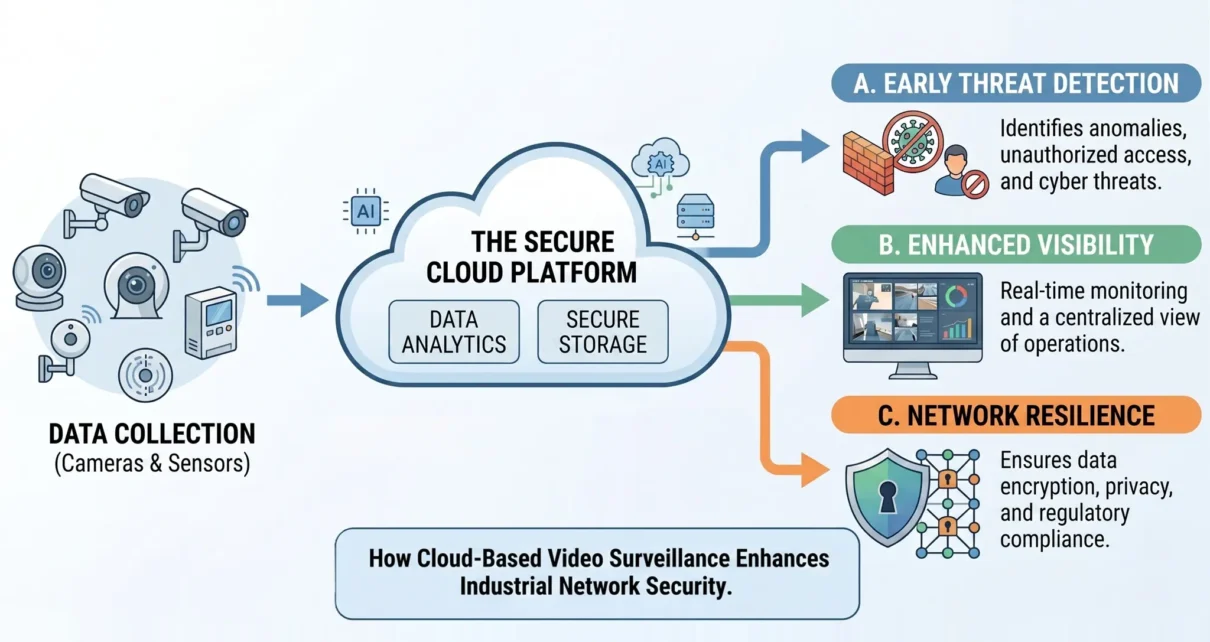
This article explores how cloud-based video surveillance enhances industrial network security and why it is essential for modern smart factories in 2026. The rapid evolution of smart manufacturing is redefining how industrial facilities approach both physical and cybersecurity.
According to industry reports, the global video surveillance market is projected to grow from approximately USD 95 billion in 2026 to over USD 261 billion by 2034, driven by increasing security demands and digital infrastructure expansion. At the same time, cloud-based video surveillance is emerging as a critical component of this transformation, with the market expected to reach nearly USD 7.97 billion in 2026 and continue expanding steadily in the coming years.
Industrial environments are also seeing rapid adoption of AI-powered surveillance, growing at over 26 percent CAGR in some segments. This shift is not just about monitoring facilities. It represents a deeper integration of operational technology (OT), IT systems, and real-time data intelligence. In smart factories, where interconnected devices and automated processes dominate, cloud-based video surveillance is becoming a foundational layer for securing complex industrial networks.
The Rise of Smart Factories and Cyber-Physical Risks
Smart factories rely heavily on Industrial IoT devices, robotics, and interconnected systems. These environments generate massive volumes of data and depend on seamless communication between machines, servers, and cloud platforms.
However, this connectivity introduces new risks. A breach in one system can quickly cascade across the network. Traditional security measures such as firewalls and endpoint protection are no longer sufficient on their own.
Industrial organizations now face a combination of threats including:
- Unauthorized physical access to restricted zones
- Insider risks and operational misuse
- Cyberattacks targeting OT systems
- Supply chain vulnerabilities
This convergence of cyber and physical threats requires a unified approach to security. Cloud based video surveillance plays a critical role in bridging this gap.
What Is Cloud Based Video Surveillance in Industrial Context
Cloud based video surveillance refers to systems where video footage is captured by IP cameras and stored, processed, and analyzed in the cloud instead of local servers.
Unlike traditional systems, cloud-based solutions provide:
- Remote access to live and recorded footage
- Scalable storage without hardware limitations
- Integration with analytics and AI tools
- Centralized management across multiple facilities
In industrial environments, this capability becomes even more powerful when combined with real-time monitoring and network intelligence.
Modern platforms such as an advanced cloud based video surveillance solution powered by providers like Coram enable factories to connect existing cameras, analyze video feeds using AI, and detect anomalies that could indicate both physical and cyber threats.
Strengthening Industrial Network Security Through Video Intelligence
Real-Time Threat Detection Across Physical and Digital Layers
In smart factories, physical access often serves as the entry point for cyberattacks. Unauthorized personnel gaining access to control rooms or network infrastructure can compromise entire systems.
Cloud based video surveillance enhances security by:
- Monitoring restricted areas continuously
- Detecting unusual behavior such as loitering or tailgating
- Triggering alerts when anomalies are identified
AI-driven analytics allow systems to identify patterns that human operators might miss. This creates a proactive security posture rather than a reactive one.
Integration with Industrial Firewalls and Network Systems
One of the biggest advantages of cloud-based surveillance is its ability to integrate with existing network security tools.
When combined with industrial firewalls and intrusion detection systems, video surveillance can:
- Correlate physical events with network anomalies
- Provide visual verification of suspicious activities
- Strengthen incident response workflows
For example, if a firewall detects unusual traffic from a specific terminal, the surveillance system can instantly provide video footage of that location. This reduces investigation time and improves accuracy.
Centralized Security Management Across Distributed Facilities
Many industrial organizations operate multiple plants, warehouses, and distribution centers. Managing security across these locations using traditional systems is complex and inefficient.
Cloud based video surveillance simplifies this by offering:
- Unified dashboards for all facilities
- Remote monitoring from any location
- Consistent security policies across sites
This centralized approach ensures that security teams have complete visibility into operations, regardless of geographical location.
Enhanced Data Protection and Compliance
Regulatory compliance is a major concern in industrial sectors such as manufacturing, energy, and pharmaceuticals.
Cloud-based systems support compliance by:
- Providing secure data storage with encryption
- Maintaining detailed audit trails
- Enabling controlled access to sensitive footage
Additionally, cloud platforms often include redundancy and backup mechanisms, reducing the risk of data loss.
Scalability for Growing Industrial Operations
As factories expand and adopt more connected devices, their security needs grow as well.
Cloud based video surveillance offers unmatched scalability:
- Add new cameras without major infrastructure changes
- Increase storage capacity instantly
- Integrate new analytics features over time
This flexibility is essential for organizations transitioning to Industry 4.0 environments.
The Role of AI in Cloud Based Surveillance Systems
Artificial intelligence is transforming video surveillance from a passive tool into an active security system.
AI-powered features include:
- Object detection and classification
- Facial recognition and identity verification
- Behavioral analysis and anomaly detection
- Automated alerts and reporting
In industrial settings, AI can detect safety violations, monitor worker compliance, and identify operational inefficiencies.
The integration of AI with cloud infrastructure allows for advanced processing capabilities that are not feasible with on-premise systems alone.
Improving Incident Response and Forensics
When a security incident occurs, response time is critical.
Cloud based video surveillance improves incident management by:
- Providing instant access to relevant footage
- Enabling keyword or event-based video search
- Supporting real-time collaboration between teams
Security personnel can quickly identify the root cause of an incident and take corrective actions.
This capability is particularly valuable in environments where downtime can lead to significant financial losses.
Supporting Zero Trust Security Models
Zero Trust is becoming a standard approach in industrial cybersecurity. It operates on the principle that no user or device should be trusted by default.
Cloud based video surveillance supports Zero Trust strategies by:
- Verifying physical presence alongside digital authentication
- Monitoring access points continuously
- Detecting unauthorized movements within facilities
By combining physical and digital verification, organizations can create a more robust security framework.
Challenges and Considerations
While cloud based video surveillance offers numerous benefits, organizations must address certain challenges:
- Network bandwidth requirements for high-resolution video
- Data privacy concerns and regulatory compliance
- Integration with legacy systems
- Initial transition costs
However, advancements in edge computing and hybrid architectures are helping overcome these limitations.
The Future of Industrial Security
The future of smart factories lies in fully integrated security ecosystems that combine:
- Cloud computing
- AI-driven analytics
- Edge processing
- Real-time monitoring
Cloud based video surveillance will continue to play a central role in this ecosystem.
As industrial environments become more complex, the ability to monitor, analyze, and respond to threats in real time will be critical for maintaining operational continuity and safety.
FAQs
What is cloud based video surveillance?
Cloud based video surveillance is a system where video footage is stored and processed in the cloud, allowing remote access, scalability, and integration with advanced analytics tools.
How does cloud surveillance improve industrial security?
It enhances security by providing real-time monitoring, AI-driven threat detection, and integration with network security systems, enabling faster response to incidents.
Is cloud based video surveillance secure?
Yes, modern systems use encryption, access controls, and secure cloud infrastructure to protect data and ensure compliance with industry regulations.
Can cloud surveillance integrate with existing factory systems?
Most modern solutions are designed to integrate with existing IP cameras, firewalls, and industrial control systems, making deployment easier.
What are the main benefits for smart factories?
Key benefits include centralized monitoring, scalability, improved incident response, and enhanced protection against both physical and cyber threats.
Conclusion
Smart factories demand smarter security solutions. As industrial environments become more interconnected, traditional security approaches are no longer sufficient.
Cloud based video surveillance provides a powerful solution by combining real-time monitoring, AI-driven analytics, and seamless integration with network security systems. It not only enhances physical security but also strengthens the overall cybersecurity posture of industrial networks.
In 2026 and beyond, organizations that invest in cloud-based surveillance will be better equipped to handle evolving threats, ensure operational resilience, and maintain a competitive edge in the era of Industry 4.0.
11 Ways Industrial Firewalls Enhance Safety in Complex Factory Networks
Artificial Intelligence in Electronics: From Design to Production