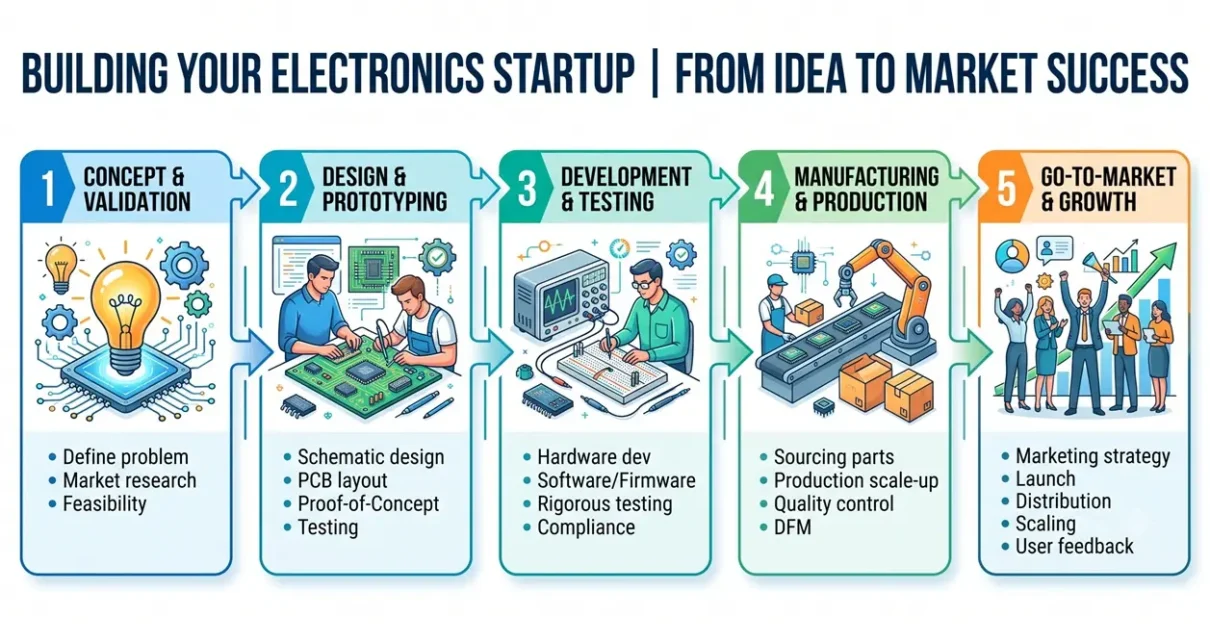
For aspiring electronics entrepreneurs with solid technical instincts and a serious interest in new venture creation, the hardest part often isn’t building, it’s building something the market will consistently pay for. The entrepreneurial journey in electronics comes with electronics startup challenges that don’t show up in prototypes, like unclear positioning, crowded categories, and real-world expectations around reliability and support. At the same time, electronics market opportunities tend to hide in specific use cases where pain is measurable and switching costs are real. With a clearer view of what makes electronics businesses viable, early decisions get simpler and momentum comes faster.
Turn an Electronics Idea into a Buildable Business Plan
This process helps you go from a rough product idea to a plan you can validate, fund, and actually deliver. For general readers, it reduces guesswork by focusing on the few decisions that determine whether an electronics project becomes a sustainable business.
- Choose a niche with a measurable pain
Start with a specific user and moment of frustration, like inventory errors in a small warehouse or unreliable sensors in a hobby greenhouse. Write a one-sentence niche statement: “I help [user] do [job] without [pain].” You are aiming for a problem that has a clear cost of failure and a buyer who can say yes. - Validate demand with fast, real-world research
Interview 10 to 15 potential customers, then confirm what you heard by scanning reviews of competing products and checking what people already pay for alternatives. Keep notes on triggers, objections, and “must-have” requirements such as battery life, durability, and warranty expectations. Use the market’s size as context, not proof, and remember the USD 1104.79 billion scale can still hide tiny segments where newcomers win. - Define your competitive advantage through focused innovation
Pick one advantage you can defend, such as easier installation, higher reliability, lower total cost, or better data and software experience. Translate it into a testable promise like “set up in 5 minutes” or “runs 6 months on one charge,” then list the design choices that make that promise true. This keeps innovation practical and prevents feature creep. - Differentiate the product, not just the spec sheet
Decide what will make buyers choose you when options look similar, such as a clearer use case, better onboarding, safer design, or a support plan that reduces downtime. Build a simple comparison table with 3 competitors and 5 buying criteria, then highlight where you are intentionally different. If you cannot explain the difference in one sentence, you probably do not have it yet. - Match funding to your build path and risk level
Estimate your first 6 to 12 months of costs, including prototypes, compliance testing, tooling, small-batch manufacturing, and returns. Then choose a funding route that fits: bootstrapping for slow and steady iteration, pre-orders for proof of demand, or investors if growth requires speed. Funding varies by category, and the fact that AI startups received $23 billion in 2023 is a reminder to align your pitch with what backers currently understand and reward.
Related Articles:
- Build a Powerful and Affordable Raspberry Pi Media Server
- Raspberry Pi Compute Module 5 (CM5) Explained
- Raspberry Pi 5 Pinout, specifications, Pricing A Complete Guide
- Raspberry Pi LED Brightness Controller
- Water Quality Monitoring System: TDS Sensor + ESP32/Arduino
- Air Quality Monitoring System – ESP32 + Blynk IoT Project
- Linux Enterprise Server vs Windows Server
Strengthen Your Go-to-Market with Business Skills That Transfer
Once you’ve turned your idea into a plan, the next lever is how confidently you can market it and make growth decisions that stick. If your technical skills are strong but you feel less certain about positioning, messaging, and the business side of getting traction, going back to school for a business degree can be a practical way to sharpen those muscles.
Whether you earn a degree in marketing, business, communications, or management, you can build skills that help your business thrive. And because online degree programs are designed for flexibility, you can keep running your electronics business while you’re in school.
If you’re weighing options to formalize your business knowledge, programs like these are worth a careful look as you plan your next step. With that foundation in place, you’ll be better prepared to tackle the common real-world roadblocks founders hit around funding, suppliers, manufacturing, QC, and marketing.
Use This Field-Tested Checklist for QC, Suppliers, and Branding
Tight operations and clear branding reinforce each other: the more consistent your build quality, the easier it is to market (and the fewer fires you’ll put out). Use this checklist to turn the common early-founder FAQs, supplier reliability, manufacturing hiccups, QC systems, and marketing, into repeatable habits.
- Write a one-page QC plan before you build the next unit: Define 5–10 measurable checks that must pass at incoming inspection, after assembly, and before packing (example: visual inspection, polarity/orientation, current draw at idle, thermal check under load, and a 10–30 minute burn-in). Add pass/fail limits and who signs off. This matters because the cost of poor quality can quietly eat margin through returns, rework, and support time, exactly the cash-flow pressure founders ask about early.
- Make traceability non-negotiable (even for prototypes): Require lot/batch IDs on every component that could cause a failure mode, then record those IDs on your build traveler or simple spreadsheet. Ask suppliers to provide documentation that supports traceability through supplier documentation and keep photos of labels for each received shipment. When a defect shows up, traceability turns “we think it’s the capacitor” into “it’s lot X from shipment Y,” which speeds root-cause fixes and protects your brand.
- Qualify suppliers with a small, brutal test order: Before committing volume, buy a low-quantity sample batch and run it through your exact QC gates plus a stress test that matches real use (temperature, vibration, duty cycle, or power spikes). Track three numbers: defect rate, lead-time accuracy, and communication speed when something goes wrong. This prevents the common “cheapest BOM” trap where you save pennies on parts but lose weeks in manufacturing delays.
- Build a supplier scorecard and review it monthly: Keep a simple table per supplier: on-time delivery %, incoming defect %, responsiveness, and how often they require urgent chasing. Share the scorecard when you request corrective actions and keep notes on what they changed. Consistent supplier relationship management reduces surprises and gives you facts to negotiate pricing, MOQs, and lead times without guesswork.
- Design for manufacturability and service from day one: As you iterate, eliminate fragile connectors, add test points for critical rails, label polarity clearly, and standardize fasteners. Write a basic assembly and test work instruction with photos so the build doesn’t live in one person’s head. This is the product manufacturing advice that prevents scale from breaking you: fewer assembly errors, faster training, and simpler repairs.
- Turn your QC story into startup marketing assets: Create one “quality promise” statement you can defend (example: “Every unit gets a functional test and a short burn-in”) and back it up with real process photos and a short test checklist excerpt. Use that proof in product pages, distributor pitches, and support docs, especially if you’re competing against lookalikes. When your operations are disciplined, your branding becomes more believable, and your marketing gets easier to sustain.
Build Momentum with Clear Launch Steps and Growth Priorities
Starting an electronics business can feel like a balancing act between building, selling, and protecting quality before problems show up. The path that works is a steady mindset: validate demand, design for manufacturability, tighten QC and supplier relationships, and let branding match what the product reliably delivers, startup confidence building comes from repeatable electronics business launch steps. When founders apply this approach, decisions get simpler, cash and reputation are better protected, and long-term business growth strategies become realistic instead of wishful. A successful electronics business is built on disciplined execution, not perfect timing.
Electronics Business FAQs Founders Ask Early
Q: How can I fund my electronics startup without huge upfront capital?
A: Start by validating demand with pre-orders, small pilot runs, or a limited SKU list so cash is tied to real sales. Mix options like microloans, revenue-based financing, and supplier payment terms to reduce pressure. Keep a simple 13-week cash forecast so you spot shortages early and act fast.
Q: What’s the safest way to verify a new electronics supplier is reliable?
A: Run a staged trial: order samples, then a small batch, then scale only after defects and lead times stabilize. Ask for traceability on key components, clear test reports, and references from similar product categories. Put everything in writing, including acceptable substitutions and packaging standards.
Q: How do I prevent manufacturing surprises when moving from prototype to production?
A: Freeze the bill of materials and define critical specs before quoting, then do a design-for-manufacturing review with your manufacturer. Even basic tolerance targets can change outcomes, and the imperial inches tolerance table shows how quickly “small” variation becomes real rework.
Q: What quality control system should I set up first?
A: Start with incoming inspection for high-risk parts, a short in-process checklist, and final functional testing tied to pass or fail criteria. Track defects by type and supplier so fixes stay focused. Growing adoption of QC tools, including a market expected to reach USD 0.86 billion by 2035, signals how valuable consistent testing becomes as you scale.
Q: How do I market electronics products when I’m not a marketing expert?
A: Lead with one clear promise, one target user, and proof like a demo video, benchmarks, or teardown photos. Choose one channel you can sustain for 60 days, such as search content, niche communities, or partnerships, then measure inquiries and conversion. Simple, repeatable messaging beats scattered campaigns.
Raspberry Pi 5 Pinout, specifications, Pricing A Complete Guide

