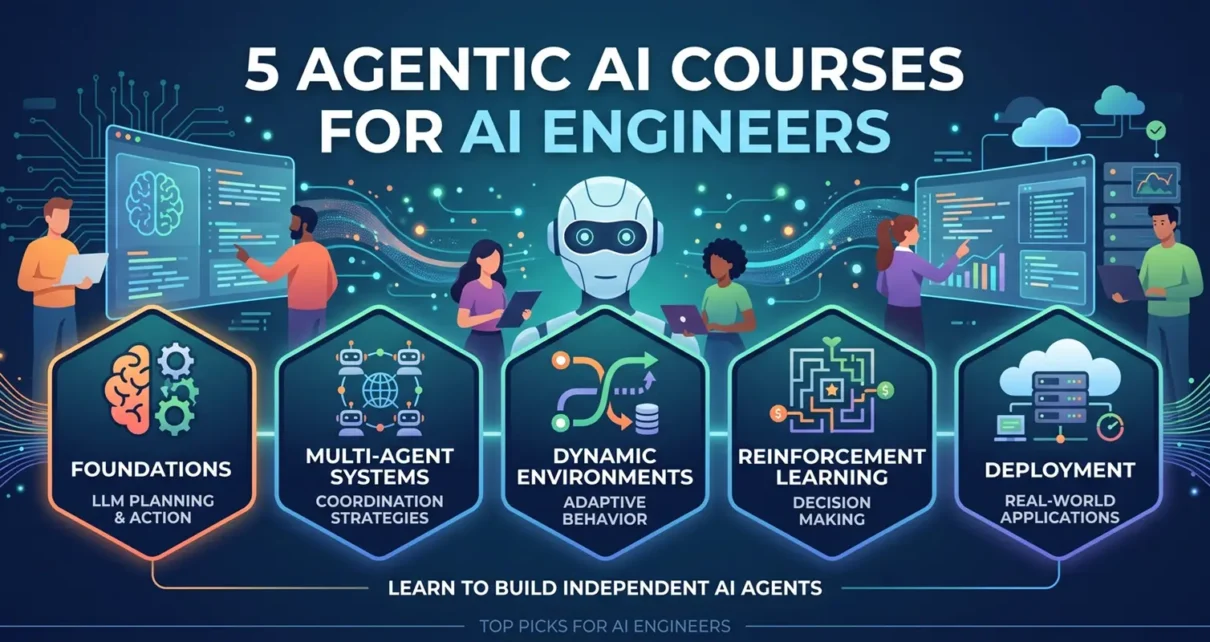
The delivery and curriculum details below reflect the current official course pages (online.lifelonglearning.jhu.edu). An AI agent can perform well during a controlled demonstration and still break once it reaches production. A tool call may expose sensitive data. Retrieval may return weak context. A multi-agent workflow may keep passing errors from one component to another without anyone noticing.
For AI engineers, building the agent is only the first part of the job. They also need methods for measuring task success, tracing decisions, controlling permissions, testing failure cases, and monitoring what happens after release.
The five programs below cover these concerns at different levels. Some provide a broad technical curriculum, while others focus on a particular cloud stack or deployment environment.
Related Articles:
- What is Artificial Intelligence in Computer Science
- Artificial Intelligence vs Human Intelligence
- Artificial Intelligence in Electronics: From Design to Production
- Cloud Video Surveillance for Network Security in Smart Factories
- Deploying Neural Networks on Microcontrollers: Tools & Techniques
How We Selected These Agentic AI Courses
- Evaluation depth: Coverage of task completion, hallucination checks, retrieval quality, and system-level testing
- Security practices: Access control, guardrails, prompt-injection defence, identity, privacy, and audit trails
- Production relevance: Deployment, monitoring, logging, tracing, CI/CD, and operational reliability
- Agent engineering: RAG, tool use, memory, planning, MCP, A2A, and multi-agent orchestration
- Applied learning: Projects, labs, case studies, or cloud-based deployment exercises
- Engineer suitability: Technical depth appropriate for developers, AI engineers, architects, and ML professionals
Quick Comparison of the Courses
| # | Course | Provider | Duration | Main Focus |
| 1 | Certificate Program in Agentic AI | Johns Hopkins University | 18 weeks | End-to-end production agent engineering |
| 2 | Building Advanced Agentic Systems on AWS | AWS Training and Certification | 1 day | Secure, observable multi-agent systems |
| 3 | No-Code Generative AI and Agentic AI | Johns Hopkins University | 12 weeks | Rapid agent workflow prototyping |
| 4 | Deploy and Govern Enterprise Agentic AI Solutions on Azure | Microsoft Learn | 3 hours 14 minutes | Governance, CI/CD, and lifecycle operations |
| 5 | Deploy Multi-Agent Systems with ADK and Agent Engine | Google Skills | 6 hours | Managed multi-agent deployment |
1. Certificate Program in Agentic AI – Johns Hopkins University
A technically strong agent can still be difficult to trust if engineers cannot explain why it selected a tool, where its answer came from, or what happened during a failed run. This AI agent certification addresses those later stages of engineering rather than stopping with basic agent construction.
The course moves from Python, LLMs, prompting, and RAG into agent evaluation, human review, multi-agent communication, observability, security, and containerised deployment.
Delivery & Duration: Online, 18 weeks
Credentials: Certificate of Completion, 13 Continuing Education Units, and a shareable e-portfolio from Johns Hopkins University
Instructional Quality & Design: Recorded JHU faculty content, faculty masterclasses, more than 16 live mentor sessions, three technical projects, case studies, and dedicated program support
Program Highlights: Python, LangGraph, LangChain, DSPy, RAGAS, DeepEval, MCP, A2A, CrewAI, AutoGen, GraphRAG, human-in-the-loop controls, neuro-symbolic guardrails, zero-trust security, logging, tracing, Docker, and CI/CD
Outcomes: Learners can build autonomous and multi-agent systems, evaluate tool use and reasoning quality, detect hallucinations, implement access controls, monitor latency and cost, and prepare agents for controlled production deployment. Projects include a financial RAG application, an autonomous research analyst, and a multi-agent mortgage underwriting system.
Why It Stands Out
- Evaluation and security are part of the core curriculum
- Covers both agent architecture and production operations
- Provides longer-term mentorship and substantial project work
2. Building Advanced Agentic Systems on AWS – AWS Training and Certification
Multi-agent systems create operational questions that do not appear in a simple chatbot. Engineers must decide how agents communicate, share memory, compress context, manage identity, and recover when one component fails.
This advanced AWS course focuses on those production concerns using Amazon Bedrock AgentCore.
Delivery & Duration: Instructor-led AWS Classroom Training, 1 day
Credentials: AWS technical classroom training rather than an exam-based professional certification
Instructional Quality & Design: Instructor presentations, demonstrations, group exercises, and a hands-on lab
Program Highlights: Multi-agent architecture patterns, agent-as-tool design, memory sharing, context optimisation, policy-based access control, VPC integration, distributed tracing, AgentCore evaluation, audit trails, compliance monitoring, API integration, and production-readiness reviews
Outcomes: Participants learn to select suitable multi-agent patterns, control access to tools, optimise context and resource use, configure monitoring, and design deployment strategies for scalable agent systems.
Why It Stands Out
- Direct attention to security and enterprise observability
- Covers production multi-agent patterns in a focused format
- Useful for engineers already working in the AWS ecosystem
3. No-Code Generative AI and Agentic AI – Johns Hopkins University
A no-code program will not replace software engineering. It can, however, help an engineer test an operating model before committing time to custom development.
This agentic AI course is useful for rapidly mapping workflows, checking whether RAG improves a task, and showing business teams how agents may interact with data and existing processes.
Delivery & Duration: Online, 12 weeks, with around 8 to 10 hours of weekly study
Credentials: Certificate of Completion and 9 Continuing Education Units from Johns Hopkins University
Instructional Quality & Design: Self-paced modules, JHU faculty masterclasses, weekly industry mentorship, graded quizzes, more than nine case studies, two business projects, and a final assessment
Program Highlights: n8n, ChatGPT, Claude, Gemini, NotebookLM, OpenAI API, prompting, RAG, workflow automation, memory, tool use, agent orchestration, multi-agent hand-offs, guardrails, responsible AI, and human oversight
Outcomes: Learners can convert a manual process into an AI-assisted workflow, connect models with business data, coordinate no-code agents, and identify where governance or approval controls are required.
Why It Stands Out
- Useful for proof-of-concept work and stakeholder demonstrations
- Connects workflow design with RAG and agent orchestration
- Allows rapid testing without building every integration from scratch
4. Deploy and Govern Enterprise Agentic AI Solutions on Azure – Microsoft Learn
Deploying an agent is not the final step. Engineering teams still need repeatable releases, identity controls, auditability, and a clear process for updating or retiring agents.
This advanced Microsoft Learn path concentrates on operating agentic systems within an enterprise Azure environment.
Delivery & Duration: Self-paced online learning path, 3 hours 14 minutes across four modules
Credentials: Microsoft Learn completion recorded through the learner profile, rather than a standalone certification
Instructional Quality & Design: Structured technical modules and implementation exercises for AI engineers and solution architects
Program Highlights: GitHub Actions, CI/CD, Microsoft Entra ID, Azure Key Vault, zero-trust security, responsible AI compliance, agent lifecycle management, Microsoft Foundry, Cosmos DB, and managed Redis
Outcomes: Learners develop a clearer approach to deploying, securing, governing, and maintaining multi-agent solutions at enterprise scale. The path is intended for engineers who already understand agent development and need stronger operational controls.
Why It Stands Out
- Focuses on governance after development
- Includes CI/CD and zero-trust security
- Fits teams building agents within Azure environments
5. Deploy Multi-Agent Systems with Agent Development Kit and Agent Engine – Google Skills
The challenge in a multi-agent system is not simply creating more agents. Engineers must define responsibilities, control the flow of work, and choose how the system will run once it leaves the local environment.
Google’s advanced course uses the Agent Development Kit to create tool-enabled agents and deploy them through Vertex AI Agent Engine.
Delivery & Duration: Self-paced online, 6 hours
Credentials: Google Skills badge after completing the course requirements or challenge lab
Instructional Quality & Design: Hands-on Google Cloud labs, guided deployment work, and an optional challenge-lab route
Program Highlights: Google ADK, agent tools, parent-child relationships, sequential and coordinated flows, local testing, Vertex AI Agent Engine, managed infrastructure, and resource scaling
Outcomes: Learners can structure multi-agent interactions, test systems locally, and deploy managed agentic flows without manually handling every infrastructure decision.
Why It Stands Out
- Concentrates on managed multi-agent deployment
- Includes practical work inside Google Cloud
- Provides a compact route to an assessed skill badge
What AI Engineers Should Check Before Enrolling
Start with the gap in your current work. Someone building prototypes may need stronger RAG, orchestration, or tool-integration skills. An engineer already shipping agents may gain more from tracing, access control, evaluation datasets, incident handling, and lifecycle governance.
Framework coverage matters, but it should not be the only deciding factor. Tools change quickly. Skills such as failure analysis, context management, least-privilege access, audit logging, and production monitoring remain useful even when the preferred framework changes.
Conclusion
A practical Agentic AI course should explain what happens after an agent produces its first successful result. Engineers need to know how that result was generated, whether the system followed the intended process, and how it behaves when a model, tool, or dependent service fails.
Evaluation, security, and deployment should therefore be treated as part of agent design, not as cleanup work added before release. The strongest learning outcome is the ability to build a system that can be tested, observed, controlled, and improved under real operating conditions.
Cloud Video Surveillance for Industrial Network Security in Smart Factories
Techniques and Tools for Deploying Neural Networks on Microcontrollers

