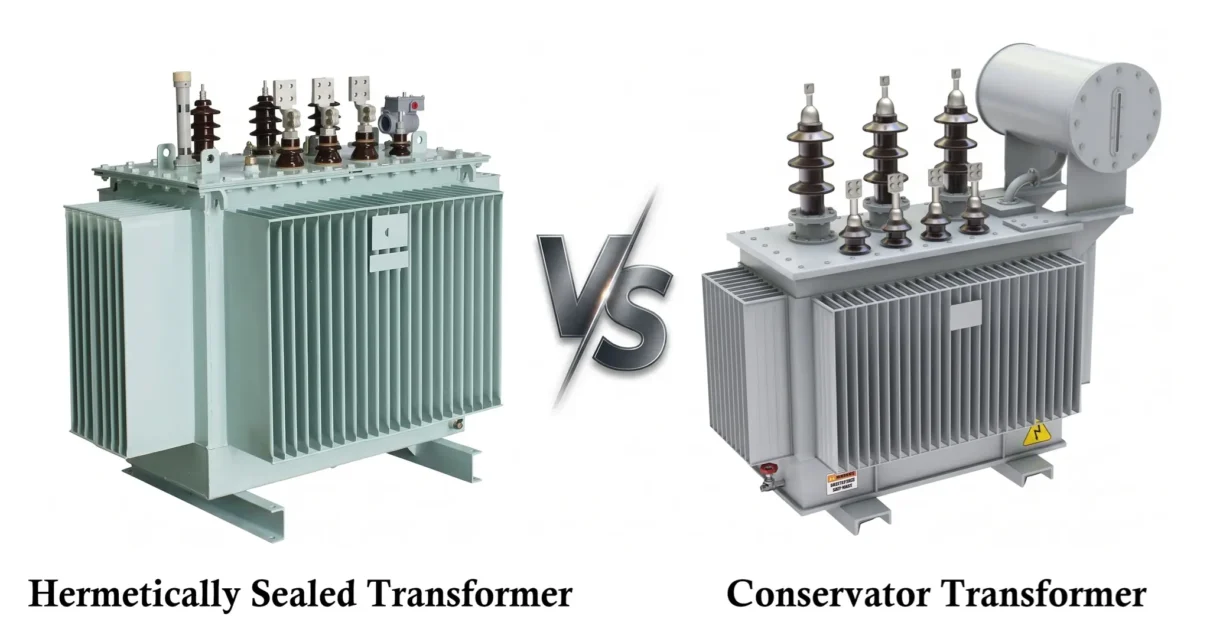
Oil-immersed transformers remain the backbone of modern electrical power transmission and distribution systems. Whether supplying electricity to residential areas, industrial facilities, renewable energy plants, or utility substations, transformers are expected to deliver reliable performance for decades with minimal downtime. One of the most important design considerations in an oil-filled transformer is how the insulating oil is protected from the surrounding atmosphere.
The two most common designs are the Hermetically Sealed Transformer and the Conservator Type Transformer. Although both perform the same electrical function of stepping voltage up or down, they differ significantly in construction, oil expansion method, maintenance requirements, insulation life, operating cost, and environmental performance.
Choosing the correct transformer design directly affects installation cost, maintenance expenses, reliability, operational efficiency, and service life. Manufacturers such as SHENGTE offer a wide range of oil-immersed transformer solutions designed to meet the varying requirements of utility, industrial, and renewable energy applications. While hermetically sealed transformers are preferred where low maintenance and protection against moisture are priorities, conservator transformers remain the standard choice for many large power and transmission applications due to their scalability and ease of monitoring.
In this article, we will compare both transformer types in detail, including their construction, working principle, advantages, disadvantages, maintenance requirements, applications, protection systems, and buying considerations to help you select the most suitable transformer for your project.
Related Articles:
- LVDT: Linear Variable Differential Transformer Explained
- Half-Wave vs Center-Tapped Full-Wave vs Bridge Rectifier
- Half-Wave Rectifier Circuit Design and Performance Analysis
- Centre-Tap Full-Wave Rectifier Circuit Design and Performance Analysis
- Bridge Rectifier Circuit Design and Performance Analysis
- Different Types of Inductors Their Properties and Applications
What is a Hermetically Sealed Transformer?
A Hermetically Sealed Transformer, also known as a fully sealed transformer, is an oil-filled transformer whose tank is completely sealed from the external atmosphere. Unlike conventional conservator transformers, the insulating oil never comes into direct contact with ambient air. This prevents oxygen, dust, and moisture from entering the transformer, significantly slowing insulation ageing and maintaining oil quality throughout its service life.

Instead of using an external conservator tank, hermetically sealed transformers compensate for oil expansion and contraction through specially designed corrugated tank walls or flexible expansion systems. As the oil temperature changes during operation, the tank walls expand and contract naturally while maintaining an airtight enclosure.
Modern hermetically sealed transformers may also include nitrogen gas cushions or flexible diaphragms to further enhance sealing performance. These designs ensure that internal pressure variations are safely managed without compromising the sealed environment.
This construction minimizes oxidation of transformer oil, reduces maintenance requirements, and improves long-term dielectric performance. For these reasons, hermetically sealed transformers are widely used in distribution networks, renewable energy installations, commercial buildings, underground substations, coastal regions, and locations where maintenance access is limited.
What is a Conservator Type Transformer?
A Conservator Type Transformer is an oil-immersed transformer equipped with an additional oil reservoir called a conservator tank. This tank is mounted above the main transformer tank and accommodates changes in oil volume caused by temperature variations.

As transformer oil heats up under load, it expands and flows into the conservator. When the transformer cools, the oil contracts and returns to the main tank. Air enters and leaves the conservator through a silica gel breather, which removes moisture before it reaches the insulating oil.
Advanced conservator designs may include oil preservation systems such as rubber bladder (diaphragm) conservators or nitrogen-sealed conservators. These systems reduce direct contact between oil and air, improving oil life and reducing moisture ingress compared to traditional open-breathing designs.
Conservator transformers are commonly used in medium, high, and extra-high voltage power systems because they can accommodate larger oil volumes and provide convenient access for inspection, oil sampling, gas monitoring, and maintenance.
Hermetically Sealed Transformer vs Conservator Transformer
| Feature | Hermetically Sealed Transformer | Conservator Type Transformer |
|---|---|---|
| Tank Design | Completely sealed welded tank | Main tank with external conservator |
| Oil Expansion | Corrugated walls or flexible expansion | Conservator tank |
| Air Contact | No | Controlled through breather |
| Moisture Protection | Excellent | Depends on breather condition |
| Breather Required | No | Yes |
| Oil Oxidation | Very Low | Higher |
| Maintenance | Minimal | Periodic |
| Typical Applications | Distribution networks | Large substations and transmission systems |
Working Principle
Both transformer types operate on the same electromagnetic induction principle. The difference lies in how they manage transformer oil expansion.
In a hermetically sealed transformer, heating causes the oil to expand and the corrugated tank walls flex outward. During cooling, the walls return to their original position. Since the tank remains completely sealed, no outside air enters the transformer.
In a conservator transformer, heated oil flows into the conservator tank. As oil cools, it returns to the main tank. Air movement occurs through a silica gel breather, allowing pressure equalization while attempting to prevent moisture from entering.
Additionally, conservator transformers often include protective devices such as Buchholz relays, oil level indicators, and temperature sensors to monitor internal conditions and detect faults early.
Cooling Methods
Both transformer types can use various cooling methods depending on their size and application:
- ONAN (Oil Natural Air Natural) – Natural oil circulation and air cooling.
- ONAF (Oil Natural Air Forced) – Fans assist air cooling.
- OFAF (Oil Forced Air Forced) – Pumps circulate oil and fans cool externally.
- OFWF (Oil Forced Water Forced) – Used in large power transformers with water cooling systems.
Hermetically sealed transformers are typically used with ONAN cooling, while conservator transformers can support more advanced cooling systems for higher capacities.
Advantages of Hermetically Sealed Transformers
- Excellent protection against moisture ingress.
- Minimal oil oxidation.
- Longer insulation life.
- Reduced maintenance requirements.
- No silica gel breather replacement.
- Lower probability of oil contamination.
- Compact construction.
- Ideal for humid, coastal, and polluted environments.
- Lower total cost of ownership over long service life.
- Improved environmental safety due to reduced oil degradation.
Advantages of Conservator Type Transformers
- Lower initial purchase cost.
- Suitable for very large power ratings.
- Easy oil sampling and testing.
- Simple maintenance procedures.
- Supports Buchholz relay protection.
- Widely used in utility substations.
- Better suited for transmission applications.
- Flexible design for high-voltage and high-capacity systems.
Disadvantages
Hermetically Sealed Transformer
- Higher initial manufacturing cost.
- Internal repairs require opening the sealed tank.
- Less convenient for oil inspection.
- Limited scalability for very large power ratings.
Conservator Type Transformer
- Requires regular maintenance.
- Oil gradually oxidizes.
- Moisture can enter if breather maintenance is neglected.
- Higher lifetime operating costs.
- Greater risk of contamination in harsh environments.
Maintenance Comparison
Maintenance requirements differ considerably between the two designs. Hermetically sealed transformers generally require only routine visual inspection and periodic electrical testing. Since the insulating oil is isolated from the environment, frequent oil testing, silica gel replacement, and conservator cleaning are unnecessary.
Conservator transformers require scheduled maintenance of the silica gel breather, oil level indicator, conservator tank, and associated pipework. Regular dissolved gas analysis (DGA), oil dielectric testing, and moisture analysis are also recommended to ensure reliable operation.
Preventive maintenance programs for conservator transformers are essential to avoid insulation failure and extend service life.
Cost Comparison
Hermetically sealed transformers usually have a higher purchase price because of their fully welded construction and specialized expansion design. However, lower maintenance requirements, improved insulation life, and reduced oil degradation often result in a lower total cost of ownership over the transformer’s lifetime.
Conservator transformers are generally less expensive initially, making them attractive for projects with limited capital budgets. However, periodic maintenance, oil treatment, breather servicing, and higher operating costs may increase overall lifecycle expenditure.
Environmental Performance
Environmental conditions play an important role in transformer selection. Hermetically sealed transformers provide superior protection in coastal regions, chemical plants, mining sites, tunnels, underground substations, and humid climates because contaminants cannot easily enter the transformer.
Conservator transformers perform well in conventional outdoor substations where regular maintenance can be carried out and environmental contamination is relatively low.
Additionally, hermetically sealed transformers reduce the risk of oil leakage and contamination, making them more environmentally friendly in sensitive locations.
Typical Applications
Hermetically Sealed Transformers
- Residential distribution systems
- Commercial buildings
- Hospitals
- Data centers
- Solar power plants
- Wind farms
- Underground substations
- Coastal installations
- Industrial facilities
- Railway electrification systems
Conservator Type Transformers
- Transmission substations
- Utility power stations
- Large manufacturing plants
- Steel industries
- Cement plants
- Petrochemical facilities
- Grid interconnection projects
- High-voltage distribution networks
- Hydropower and thermal power plants
Which Transformer Should You Choose?
The best choice depends on your operating conditions, maintenance capability, environmental exposure, and budget.
- If your installation is located in a humid, coastal, underground, or difficult-to-access location where maintenance must be minimized, a Hermetically Sealed Transformer is generally the better choice.
- If your application involves very high power ratings, utility substations, or transmission systems where regular inspection and oil monitoring are already part of maintenance procedures, a Conservator Type Transformer remains an excellent solution.
Buying Considerations
- Transformer rating (kVA or MVA)
- Primary and secondary voltage
- Cooling method (ONAN, ONAF, OFAF)
- Ambient operating temperature
- Installation environment
- Maintenance availability
- Expected service life
- Initial budget versus lifecycle cost
- Applicable IEC, IEEE, or IS standards
- Protection devices and monitoring systems
If you are looking for professionally manufactured oil-immersed distribution and power transformers, SHENGTE offers a wide range of hermetically sealed and conservator type transformers designed for utility, industrial, commercial, and renewable energy applications.
Conclusion
Both hermetically sealed transformers and conservator type transformers are proven technologies with distinct advantages. Hermetically sealed transformers provide excellent protection against moisture, reduced maintenance, improved insulation life, and lower long-term operating costs, making them ideal for modern distribution systems and harsh environments. Conservator transformers, on the other hand, remain the preferred solution for large-capacity power transformers because of their scalability, ease of inspection, and suitability for high-voltage applications.
Before selecting a transformer, evaluate the installation environment, maintenance resources, operating conditions, expected service life, and total ownership cost rather than focusing solely on the initial purchase price. A well-informed choice will improve system reliability, reduce downtime, and maximize long-term investment.
Frequently Asked Questions (FAQ)
1. Which transformer requires less maintenance?
Hermetically sealed transformers generally require less maintenance because the insulating oil is isolated from air and moisture.
2. Which transformer has a longer service life?
Under similar operating conditions, hermetically sealed transformers often achieve a longer insulation life due to reduced oil oxidation.
3. Why is a conservator tank used?
It accommodates oil expansion and contraction caused by temperature changes while maintaining the required oil level.
4. Which transformer is better for coastal regions?
Hermetically sealed transformers are generally preferred because they provide superior protection against humidity and salt-laden air.
5. Are conservator transformers still widely used?
Yes. They remain the standard choice for many medium-, high-, and extra-high-voltage transmission and distribution applications worldwide.
6. Can hermetically sealed transformers be used for high voltage?
They are mainly used for distribution-level voltages, but advanced designs can be applied in medium-voltage systems.
7. What standards apply to these transformers?
Common standards include IEC 60076, IEEE C57 series, and IS standards depending on the region.
Different Types of Inductors Their Properties and Applications
Comparison of Half-Wave, Center-Tapped Full-Wave, and Bridge Rectifiers
Centre-Tap Full-Wave Rectifier Circuit Design and Performance Analysis

