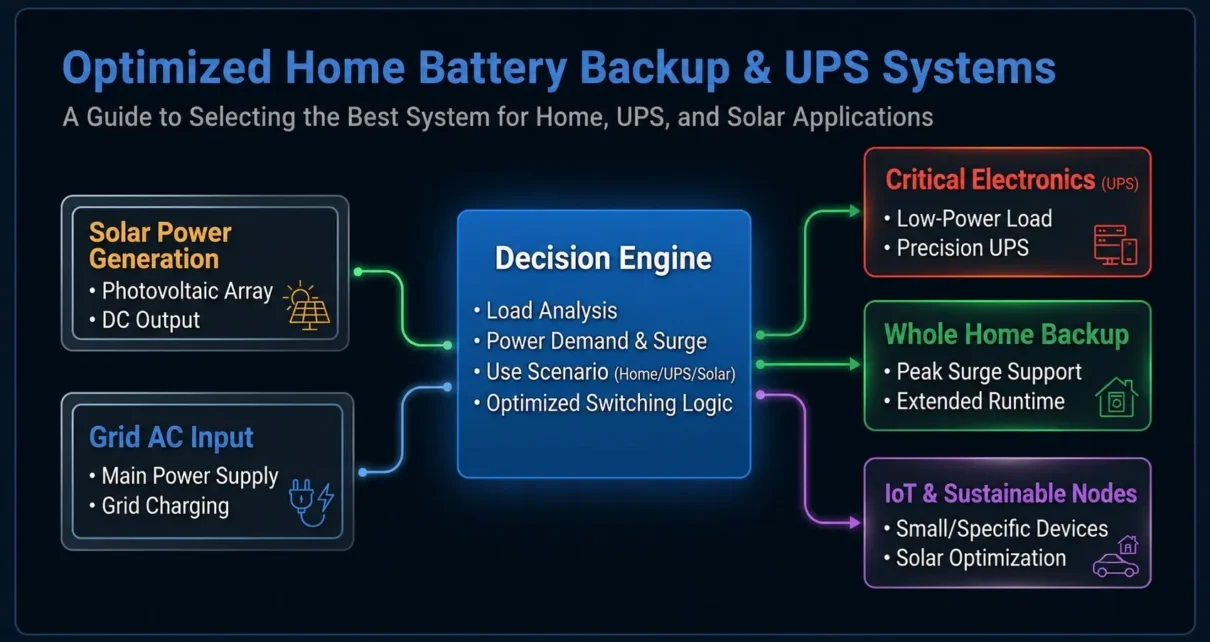
Battery backup systems are not just emergency batteries, they are complete power continuity systems designed to keep critical devices running when grid power becomes unstable, unavailable, or fluctuating beyond safe thresholds.
In real-world applications, these systems are used across multiple layers of modern energy infrastructure, including home energy storage systems, UPS protection systems for computers and servers, solar hybrid backup systems, and low-power embedded electronics such as IoT devices.
Choosing the best battery backup system is not only about capacity, but it also depends on load type, surge demand, response time, and whether the system is designed for short-term bridging or long-duration energy independence.
This guide breaks down how battery backup systems actually work, compares the most widely used architectures, and helps you identify the right solution based on real engineering and usage scenarios rather than marketing specifications.

What is a Battery Backup System?
A battery backup system is an engineered power continuity solution designed to maintain electricity supply when the main grid becomes unstable or completely unavailable. Unlike a simple battery, it is a complete energy management architecture that coordinates storage, conversion, and load regulation in real time.
In practical deployments, these systems are used across residential homes, industrial control systems, data centers, and increasingly in IoT and embedded electronics environments where stable low-power backup is critical.
Related Articles:
- LR44 Button Battery Equivalent: All You Want to Know
- Automatic Battery Charger circuit using LM358 OP-AMP
- Half-Wave vs Center-Tapped Full-Wave vs Bridge Rectifier
- 1S, 2S, 3S, 4S BMS Circuit Diagram for Li-ion Batteries
- Different Types of Solar Panels & How to Select Best One?
- Multi Junction Solar Cells – Efficiency Beyond Conventional Limits
The complexity of a battery backup system depends heavily on its scale. A small UPS for a computer may only require basic switching logic, while a home energy storage system requires multi-layered control over charging cycles, inverter efficiency, and thermal safety.
For a deeper engineering breakdown of system architecture, see battery backup power supply system architecture

How Battery Backup Systems Work
Battery backup systems do not operate as simple charge-and-discharge devices. Instead, they function as dynamic energy control systems that continuously evaluate power conditions in real time.
In low-power embedded systems, different battery chemistries are used depending on stability requirements. For example: NiMH rechargeable battery applications for embedded systems are commonly used in small-scale backup designs.
At the core of operation is a continuous decision loop that monitors grid stability, load demand fluctuations, and internal battery health to determine when to switch between power sources.
This is especially critical in environments where even milliseconds of delay can cause system failure, such as servers, industrial controllers, or sensitive electronics.

In real implementations, this process is governed by inverter logic, controller ICs, and protection circuits that respond instantly to electrical fluctuations. In low-power applications such as embedded systems, NiMH battery packs are sometimes used due to their stability, safety profile, and simplicity compared to lithium-based systems.
Best Home Battery Backup Systems (High Power Solutions)
Home battery backup systems are designed to provide long-duration power support during extended grid outages, making them suitable for residential environments where energy stability is critical for heating, cooling, communication, and essential appliances.
Unlike small UPS devices, these systems operate at much higher energy capacities and are typically integrated into household electrical panels. They must handle both steady loads and sudden surge demands when multiple appliances start simultaneously.
Modern solutions such as Tesla Powerwall 3, EcoFlow DELTA Pro Ultra, and Anker SOLIX E10 are widely used because they combine smart energy management, modular expansion, and hybrid power input from solar or generators.

These systems are commonly selected based on energy demand, surge capacity, and integration with solar energy systems or hybrid backup configurations.
UPS Battery Backup Systems for Electronics
UPS systems are designed for instantaneous power switching, meaning they activate within milliseconds when grid power fails. This makes them essential for protecting sensitive electronic equipment where even a short interruption can cause data loss or system instability.
In real deployments, UPS systems are commonly installed in environments such as office computers, network routers, enterprise servers, and industrial monitoring systems. Their main purpose is not long-term energy supply but seamless transition between grid power and backup battery output.
Advanced UPS systems also include voltage regulation, surge protection, and battery health monitoring to ensure long-term reliability under frequent switching conditions.

UPS systems provide instant switching through internal battery systems, ensuring that computers, servers, and networking equipment remain operational even during sudden power loss.This makes them essential in data centers, office environments, and any system requiring continuous uptime.
Battery Backup Systems for Solar Energy
Solar battery backup systems are energy storage architectures that capture electricity generated from photovoltaic panels and store it for later use when sunlight is unavailable or grid power is unstable.
Unlike grid-only backup systems, solar-based solutions operate as a continuous energy cycle, combining generation, regulation, storage, and discharge into a single integrated system.
These systems are especially important in residential solar installations and hybrid energy environments where users want both energy independence and long-term cost efficiency.
Typical applications include residential solar backup systems, hybrid solar-grid setups, and off-grid energy systems used in remote locations or critical infrastructure.

In real-world deployments, solar backup systems are often combined with grid-tied inverters and hybrid controllers to ensure uninterrupted power delivery even during extended outages or unstable weather conditions.
Low-Power Backup Systems for Small Electronics  (NiMH Entry Core)
Low-power backup systems are designed for electronic devices that operate under minimal energy consumption conditions, where high-capacity lithium-based storage is unnecessary or inefficient.
These systems are widely used in IoT devices, embedded controllers, wireless sensors, and compact electronic modules that require stable and long-duration backup power without complex energy management systems.
Unlike home or industrial-scale backup systems, low-power architectures prioritize safety, simplicity, low cost, and predictable discharge behavior rather than high energy density or surge capacity.

In these applications, energy demand is extremely low, but stability requirements are high, meaning the system must maintain consistent voltage output over long periods without frequent maintenance or battery replacement. Because of this, AA/AAA-based chemistries are still widely used in embedded backup systems where safety and simplicity are more important than raw energy density. In low-power backup applications, AA/AAA NiMH rechargeable battery packs for low-power backup systems are commonly used as a safe and cost-effective solution for small electronics and embedded systems.
For technical specifications and application details, you can explore: NiMH rechargeable battery solutions for embedded and low-power systems
Typical applications include:
- Environmental monitoring sensors
- Smart home IoT devices
- Wireless communication modules
- Embedded microcontroller systems
- DIY electronics projects
The key design focus of low-power backup systems is not energy capacity, but long-term reliability, ultra-low standby consumption, and predictable discharge behavior under minimal load conditions.
Battery Types Used in Backup Systems
Battery backup systems use different battery chemistries depending on power demand, application scale, and required runtime performance.
Each chemistry has a specific role in modern energy systems, ranging from high-capacity home storage to low-power embedded electronics.

In practical deployments, lithium-ion batteries dominate high-capacity energy storage systems, while lead-acid batteries remain widely used in traditional UPS and backup power infrastructure.
In contrast, NiMH rechargeable battery systems are still relevant in low-power embedded applications where safety, simplicity, and stable discharge behavior are more important than energy density.
Which Battery Backup System is Best?
There is no universal “best” battery backup system because the optimal choice depends entirely on the application scenario, power requirements, and expected runtime.
Instead of focusing on a single solution, modern energy design evaluates systems based on usage scale, from household backup to electronics protection and low-power embedded applications.

For most users, Tesla or EcoFlow systems are ideal for whole-home backup, UPS systems are best for computers and servers, solar systems are optimized for renewable energy storage, and NiMH-based systems remain the most practical choice for low-power embedded applications.
Key Factors to Consider When Choosing a Battery Backup System
Choosing the right battery backup system is not just about capacity. It requires evaluating multiple technical and practical factors that directly affect performance, reliability, and long-term usability.
Depending on your applications, whether it is home energy storage, UPS protection, solar integration, or low-power embedded systems each factor plays a different role in system selection.

When selecting a system, users should always match these factors against their real-world application scenario rather than focusing on specifications alone. For example, home battery backup systems prioritize capacity and surge output, while UPS systems prioritize response time, and IoT low-power systems prioritize efficiency and stability over raw power.
Conclusion
Battery backup systems vary significantly depending on power demand, application type, and system architecture.
While lithium-based systems dominate modern home energy storage and high-power applications, they are not always the optimal solution for every use case.
In low-power and embedded environments, NiMH battery systems remain highly relevant due to their safety, stability, and cost-effectiveness.
Ultimately, the best system is determined by matching energy requirements with the correct battery chemistry and system architecture.
Frequently Asked Questions (FAQ)
What is the best battery backup system for home use?
The best home battery backup systems are typically lithium-based solutions such as Tesla Powerwall or EcoFlow systems, offering high capacity and whole-home energy support.
For smaller-scale applications such as electronics or low-power devices, simpler systems may be more suitable depending on load requirements.
What is the difference between UPS and battery backup systems?
A UPS (Uninterruptible Power Supply) provides instant backup power during outages, mainly for computers and sensitive electronics.
Battery backup systems are broader and can include UPS devices, home energy storage systems, and solar battery storage solutions.
How long do battery backup systems last?
The runtime depends on system capacity and load conditions:
- Small UPS systems → 10–30 minutes
- Home battery systems → several hours to days
- Solar hybrid systems → potentially continuous with recharge
What battery type is best for backup systems?
Different battery chemistries are used depending on application requirements:
- Lithium-ion → high-power home and solar systems
- Lead-acid → traditional backup systems
- NiMH → low-power and embedded systems ⭐
NiMH is commonly used in small electronics, IoT devices, and portable backup applications where safety and simplicity are more important than high capacity.
Can I use AA batteries for a backup power system?
Yes, AA batteries can be used in low-power backup systems when properly configured.
Rechargeable AA NiMH batteries are often used in sensor systems, embedded devices, and DIY electronics projects.
They are typically paired with a boost converter to ensure stable output voltage.
Do battery backup systems work during long power outages?
Yes, but runtime depends on system type and capacity.
- UPS systems → short-term bridging
- Home battery systems → extended backup
- Solar systems → long-duration or continuous operation
- Small battery systems → limited runtime for low-power devices
What is the most cost-effective battery backup solution?
Cost-effectiveness depends on application scale:
- Home systems → lithium modular storage systems
- Electronics → UPS systems
- Low-power applications → AA NiMH rechargeable battery packs ⭐
https://www.hackatronic.com/different-types-of-solar-panels-how-to-select-best-one/
Multi Junction Solar Cells – Efficiency Beyond Conventional Limits
Comparison of Half-Wave, Center-Tapped Full-Wave, and Bridge Rectifiers

